 software-architecture.ai
Software Design vs. Software Architecture: The Difference That Keeps Your Software Future-Proof
You know that moment? The software runs, the build went surprisingly fast. Then you ask for one small thing: an extra field on the customer record, a second location, a different payment provider. And the quote comes back: three weeks. You think: “It's just a button.”
The good news first: this gap between cheap changes and expensive ones is not bad luck, and it is not someone trying to rip you off. It has a name. Today is about the difference between software design and software architecture, and why exactly this difference now decides the future of your software. If you know it, you can have software built that survives change instead of breaking under it.
The short version, before the detail: software design is the many small decisions that stay cheap to change later. Software architecture is the few decisions that become expensive or nearly impossible to change. Textbooks like to explain this with layer models and diagrams. I want to look at it through a different lens: what does each kind of decision cost you when you run a small business? And why is AI shifting that math so fundamentally right now?
Software architecture
The sum of the foundational decisions in a software system that are expensive or impossible to change later: system boundaries, data model, dependencies, interfaces. Everything else is design.
What is the difference between software architecture and software design?
Software architecture covers the foundational decisions that are expensive to change later: system boundaries, data model, dependencies. Software design is the many local decisions made inside those boundaries.
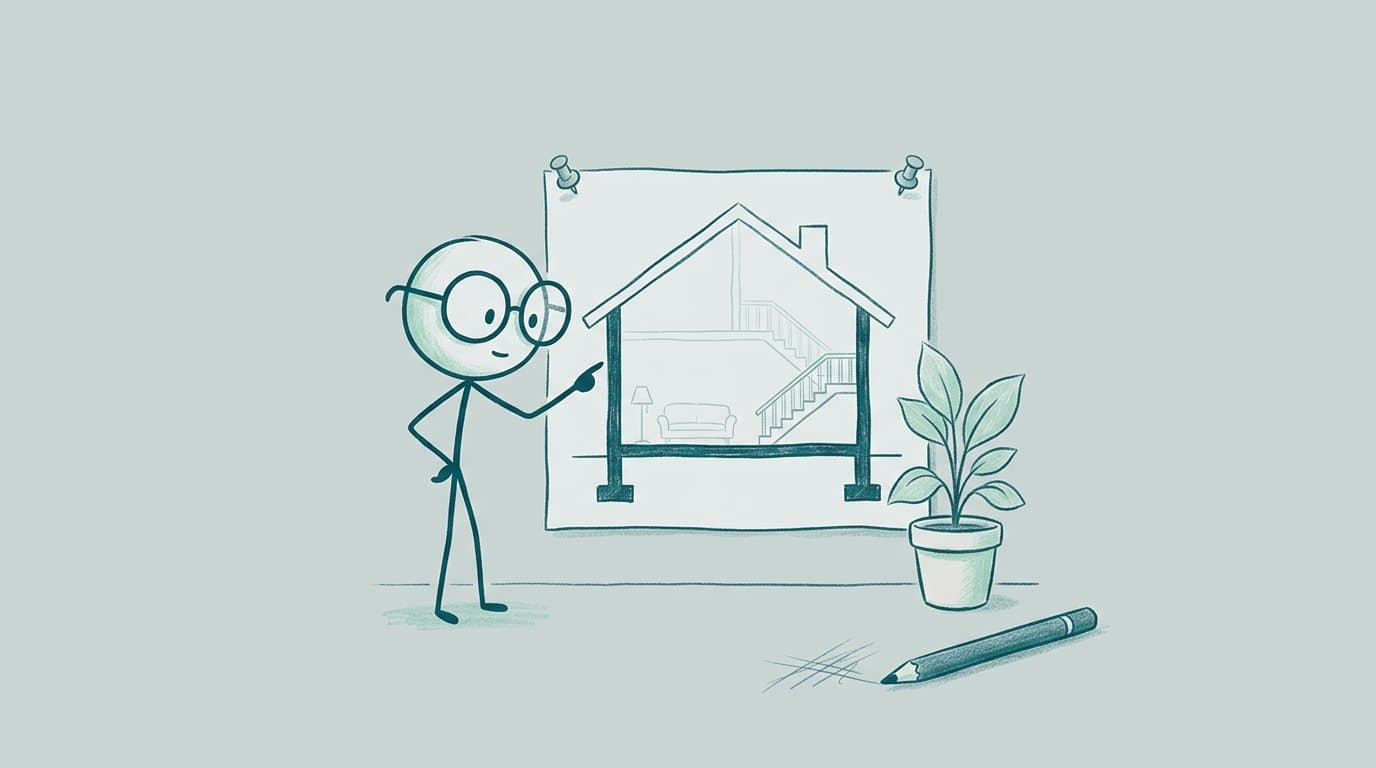
The classic example for software architecture is a house. Rearranging furniture, painting walls, hanging a new lamp: that's an afternoon. That is design. Moving a load-bearing wall, relocating the bathroom to another corner because that's where the plumbing runs, widening the foundation: that takes a structural report, it makes dust, and it costs real money. That is architecture.
Here's the punchline: from the outside, both requests look small. “Swap the lamp” and “remove that wall” are both one sentence. The price difference is not in how visible the change is. It is in how much hangs on it.
Translated into software: what a “customer” looks like in your data, which systems talk to each other and in what format, which provider you tie yourself to for hosting, login or payments, whether your system runs as one big block or in modules: all architecture. How a single form is built, what a function looks like inside, button color, wording, the order of fields: all design.
There is a lovely old line for this in the field, going back to Ralph Johnson and Martin Fowler: “Architecture is about the important stuff. Whatever that is.” It sounds flippant, but it means exactly this: the line between design and architecture is not technical, it is economic. Whatever is expensive to change is architecture.
Strictly speaking, architecture is itself part of design: the top layer of design decisions. For everyday use, the separation is still worth gold, because it tells you exactly where to look.
The Cost-of-Change Map
Click through six change requests and see what each one touches in the house.
How do you recognize an architecture decision?
By asking three questions: How many places depend on it? What would reversing it cost in a year? And does it tie you to a provider, a format, or a person?
- How many places in the system depend on this decision? The button color: one place. The format of your customer numbers: everywhere. Invoices, reports, interfaces, exports.
- What does it cost to reverse the decision in a year? Changing a label: minutes. Switching the database or the payment provider: a migration, with testing, with risk, with sleepless nights.
- Does it tie you down? To a provider, a data format, or to the one person who is the only one who understands how it all fits together.
My rule of thumb: if two out of three questions hurt, you are making an architecture decision. Even if it feels small.
And here is the part that gets lost in everyday work: these decisions get made even when nobody makes them consciously. The vibe coding tool makes them. The agency makes them on the side. The AI makes them in seconds. The question is never whether architecture decisions are being made. The question is whether anyone is watching.
Why does software architecture matter more when AI writes the code?
Because AI makes the design level nearly free while making architecture decisions implicitly and short-sightedly. What gets produced cheaply needs a deliberate structure around it.
Now to the data. According to the Stack Overflow Developer Survey 2025, with around 49,000 respondents from 177 countries, 84% of developers use AI tools or plan to (Source: Stack Overflow, 2025). At the same time, trust in the accuracy of the results fell from 40% to 29%. In plain terms: people lean on the tools more and trust them less. The biggest frustration: solutions that are almost right, but not quite. 66% say they spend more time fixing that almost-right code (Source: Stack Overflow, 2025).
Second data point: GitClear analyzed 211 million lines of code from 2021 to 2025. The share of restructured code, the actual cleanup work, fell from 25% to under 10% in that period. The share of copy-paste rose from 8% to 18% (Source: GitClear, 2026). Translated for everyone who doesn't code: things get built faster and cleaned up less. Perfectly fine for a weekend experiment. Not fine for the system your revenue runs on.
And now the finding that, for me, is the most important one this year. The DORA Report 2025 by Google, close to 5,000 respondents, concludes: AI is an amplifier. Throughput goes up, stability goes down. And the decisive sentence behind it: teams with loosely coupled, modular software architecture see real gains. Teams with tightly tangled systems see little or nothing (Source: Google Cloud / DORA, 2025).

So software architecture is the dial that decides whether AI speed reaches you or fizzles out as instability. What sounds like a threat, “AI writes the code now”, is a lever for everyone who builds deliberately.
When code gets cheap, structure gets valuable.
To be fair, there is a flip side: AI also makes architecture changes themselves more accessible. A migration that would have been a months-long project two or three years ago can move much faster today with agent support. You can experiment and iterate at the architecture level too, working more agile in this area than was ever possible. That is a fundamental shift. Two things do not change, though: the order stays, architecture changes still cost a multiple of design changes. And safe rebuilds require exactly the guardrails this article is about: tests, modules, clear boundaries. If you build deliberately, you get both: cheap design and an architecture that stays movable. Even the way out of a closed platform gets shorter: the old prototype is the best specification a rebuild can have, and AI generates fast from a specification. Ownership still remains architecture decision number one, because it decides whether you can remodel or have to rebuild.
On top of that: AI makes architecture decisions in passing. It optimizes for the application it has in front of it right now, not for the one you will need in six months. An experienced human weighs where you want to go and decides deliberately. Grady Booch, one of the fathers of modern software architecture, put it plainly in a conversation with InfoQ in early 2026: when AI-generated code fails in production, the human with the architecture view stays accountable (Source: InfoQ, 2026). You cannot delegate accountability to a language model. I explored why exactly this kind of judgment becomes the core of the new developer role in “The Slow Death of the Programmer”.
What does this mean for you when you have software built?
You don't need a computer science degree. You need three questions you ask before every project, whether it's an agency, a freelancer or a vibe coding tool.
What I bring from my own work is a conviction: the most expensive decisions in a software project are the ones nobody made consciously. So these are the three questions that protect you from expensive surprises:
- “Who owns this, and in what format can I leave?” Code, data, access. If the answer is vague, someone else is making an architecture decision for you right now.
- “Which three decisions will we no longer be able to change cheaply in a year?” Whoever has no answer hasn't thought about it. Whoever names three and explains why they were made that way is someone you can work with. It also happens to be a wonderful question for comparing providers.
- “Where are the boundaries in the system?” Is it cut into modules, so the inside can move fast and even get sloppy without the whole thing wobbling? That is exactly the loose coupling from the DORA finding. It is the reason AI speed arrives for some and not for others.
There is one more shift I find fascinating: architecture work increasingly means building decision environments. Approved patterns, guardrails, standards, inside which humans and AI agents can safely move fast. Architecture becomes the invisible structure guiding thousands of small decisions every day (Source: CIO.com, 2026). I looked at why professional standards become more important with AI, not less, in “Beyond Vibe Coding”.
And one thought that gets too little airtime in this whole debate: small businesses have a real advantage here. No corporate legacy system, no twenty years of tangle. If you are small today and build deliberately, you can have a structure the big players dream of. And that is exactly when AI speed pays off in full.
The one question to take with you
You don't have to become an architect. But there is one question you can carry into every software conversation from today on: “Which decisions here are expensive to change, and who is making them consciously right now?” If the honest answer is “nobody”, that is the moment for a critical look. Before building, not after.
That look is exactly what I offer: as guidance before you build, or as an audit for what already exists. If this is on your mind right now, I'll gladly take a look with you.
And for what comes next: the more code gets written by agents, the more it matters to have someone in the room who knows which walls are load-bearing. That is not nostalgia. That is the new division of labor: the machine delivers speed, the human delivers direction.
Related to This Topic
Get the free Getting Started Guide: 10 concrete ways to start using AI productively tomorrow.
Did this article spark an idea? Let's find out which Sinnvampire can disappear for you.