 software-architecture.ai
Custom software used to be only for the big players. Now you build the first step yourself.
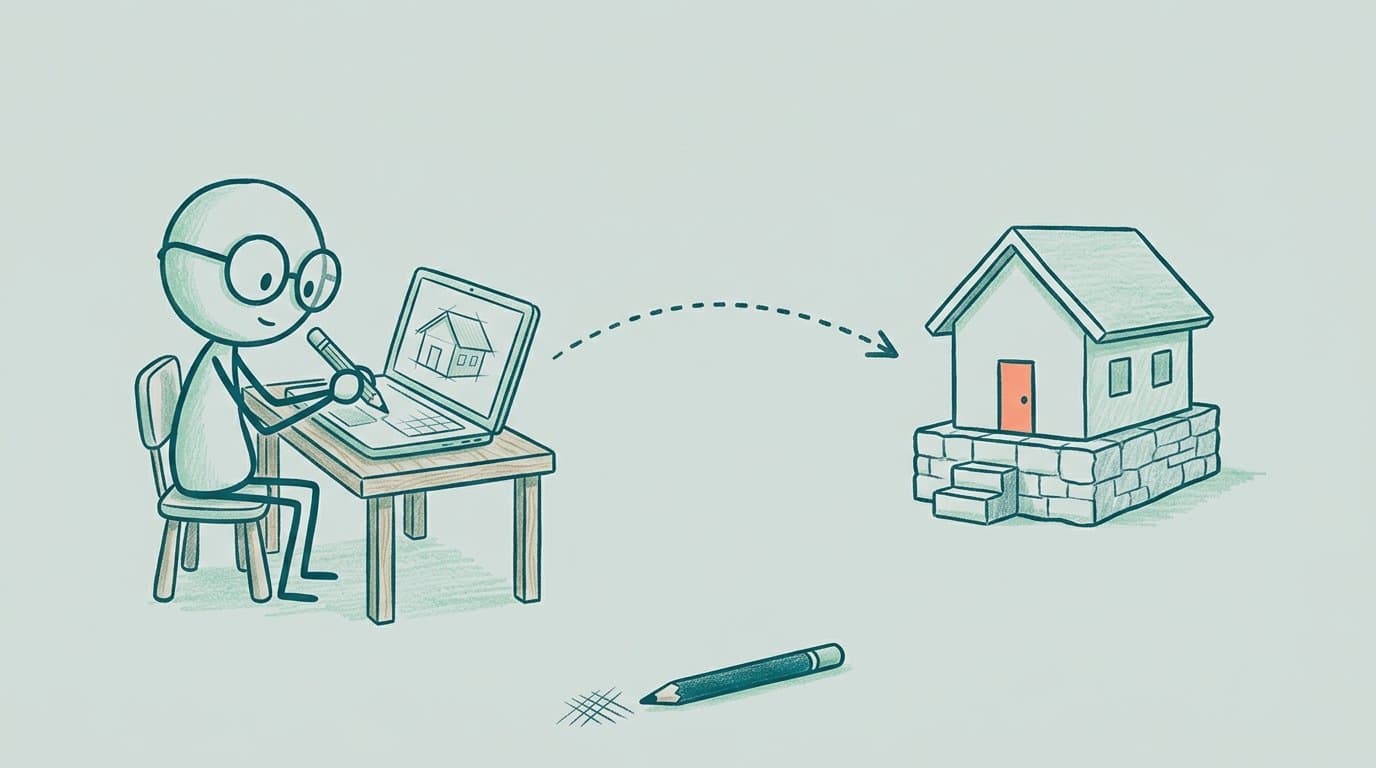
A solution that fits your business exactly, instead of one off the shelf: for years, that was the big players’ turf. Budget, IT department, six-figure project. If you were small or working alone, the message was: take a standard tool and make peace with what it can’t do.
That’s no longer true. Custom software has become affordable. Not a little cheaper, but on a different order of magnitude. And the wild part: you can take the first step yourself, over a weekend, without writing a single line of code.
This isn’t tool marketing, it’s the architecture view: part of what used to make bespoke software so expensive, the first working draft, now costs you almost nothing. That doesn’t just shift the price. It shifts who can afford this kind of software at all. And it changes what the path there looks like. That path, from the first draft to something that genuinely holds up, is what I want to talk about honestly here.
Why is custom software suddenly affordable even for small teams?
Because the most expensive part, the manual work, is no longer the whole bill. A classic custom-software project used to sit in a league that locked small teams out.
The numbers are sobering. An average custom-software project recently ran at around $132,000 and a good year of build time (Source: Clutch / Founders Workshop, 2026). That was the old world. What broke it open is AI-assisted development. About a quarter of the startups in Y Combinator’s Winter 2025 batch had codebases that were roughly 95 percent AI-generated (Source: TechCrunch, 2025). These aren’t weekend experiments, they’re companies raising real money. Even Microsoft reports that up to 30 percent of its own code now comes from AI (Source: TechCrunch, 2025).
Drag the slider
The rest, having the custom software built, now fits a small budget.
Old world: Clutch / Founders Workshop, 2026
For you, that means: having custom software built is realistic for small budgets for the first time. And you don’t even have to wait for someone to start. You take the first step yourself. With vibe coding, you describe what you need in plain language, and an AI builds the first prototype. How this describe-instead-of-type works, and where the line between “it runs” and “it holds up” sits, I unpacked in “Vibe Coding: what it is and when it holds up”.
What good is a self-built prototype if I’m not a developer?
More than you’d think. But not as a finished product, as a launch ramp. Many confuse the two, and both mistakes are expensive: treat the prototype as the finished product and you go live too early. Treat it as a toy and you throw away the most valuable thing a software project can have.
What you built yourself shows in black and white what the software is meant to do. No requirements document where everyone talks past each other. Something you can actually touch. Three things have become important to me in my work:
- Validate before you invest. You test the idea on the running prototype before you put money into the actual build.
- Talk with something in hand. When you then have custom software built, you don’t start from zero. You start with something that already shows where it’s headed. That saves the most expensive phase: the misunderstanding.
- A solution that fits you. No more bending yourself around a standard tool. The software follows your business, not the other way around.
This exact path gets recommended from the outside too. Forbes put it plainly in early 2026: the best approach is to get from zero to one with AI, then bring in technical expertise to harden and scale what you’ve built (Source: Forbes, 2026). Being alone is no disadvantage here. Small, fast, close to your own idea. That’s the advantage.
When should I have custom software built instead?
A simple rule of thumb: as long as only you or your team uses the prototype, go ahead. The moment real customers, sensitive data, or money are involved, it pays to have custom software built rather than pushing the quick build live. Because what gets built fast quietly bakes in risks you can’t see from the outside.

The real reason isn’t this or that security flaw. It’s what a human brings and an AI doesn’t: a plan, a vision, knowledge of your technical constraints, and an architecture concept built for growth. An AI builds what’s in the prompt. It doesn’t know where you want to be in two years, and it doesn’t decide what still holds when ten users turn into a thousand.
How shaky the raw code output can be shows in a snapshot. In 2025, Veracode tested over a hundred language models: 45 percent of AI-generated code contained security flaws, on average 2.74 times as many as human-written code (Source: Veracode, 2025). Another study found design flaws or known vulnerabilities in 62 percent of AI code solutions (Source: Cloud Security Alliance, 2025). Read numbers like these with care: in the AI world, a year-old study is practically the stone age, and the next model generation scores differently again. What doesn’t change is the principle behind it. The AI optimizes for the task in the prompt, not for the path ahead of you.
Even the refining that makes self-building so powerful doesn’t steer itself in the right direction without human oversight. In a controlled experiment across 40 rounds, originally clean code picked up new weaknesses through repeated AI revision (Source: arXiv, 2025). Not because the AI is bad, but because no one held the big picture.
What the step to “having it built” actually adds is three things: durability, so the build holds up when far more people use it. Technical vision, an architecture that grows with you instead of slowing you down after six months. And ownership, the certainty that what was built belongs to you and that you can carry it forward without outside help.
The experienced eye isn’t a verdict on what you built. It’s the structural check under the house you put up over a weekend.
The house stands. The only question is whether someone looked at the foundation before you move in. And that doesn’t take an in-house team. Technical leadership exists on loan, for the hours it actually matters. What that looks like is in “What is a fractional CTO?”.
From prototype to product: your next step
Custom software is no longer just for the big players. Take the first step yourself, vibe-code your prototype, that’s the best thing that can happen to your idea. And when it’s meant to become something real, don’t walk the path from prototype to product alone, but with an experienced eye at your side. That’s exactly where I come in, from custom software development to the point where your product genuinely holds up.
The rule to take with you: build it yourself for internal use and for testing. The moment customers, data, or money are attached, have it built before it goes live. If you’ve built something and honestly want to know whether it holds up and what it would take to become a real product, show it to someone who knows where prototypes tip over. That’s not a big step. It’s the right second one.
The question is no longer whether you can afford bespoke software. You can. The question is whether you have it built so that it still carries you tomorrow.
Related to This Topic
Get the free Getting Started Guide: 10 concrete ways to start using AI productively tomorrow.
Did this article spark an idea? Let's find out which Sinnvampire can disappear for you.