 software-architecture.ai
Brand Voice with AI: Why AI Text Sounds Generic and What Makes It Sound Like You
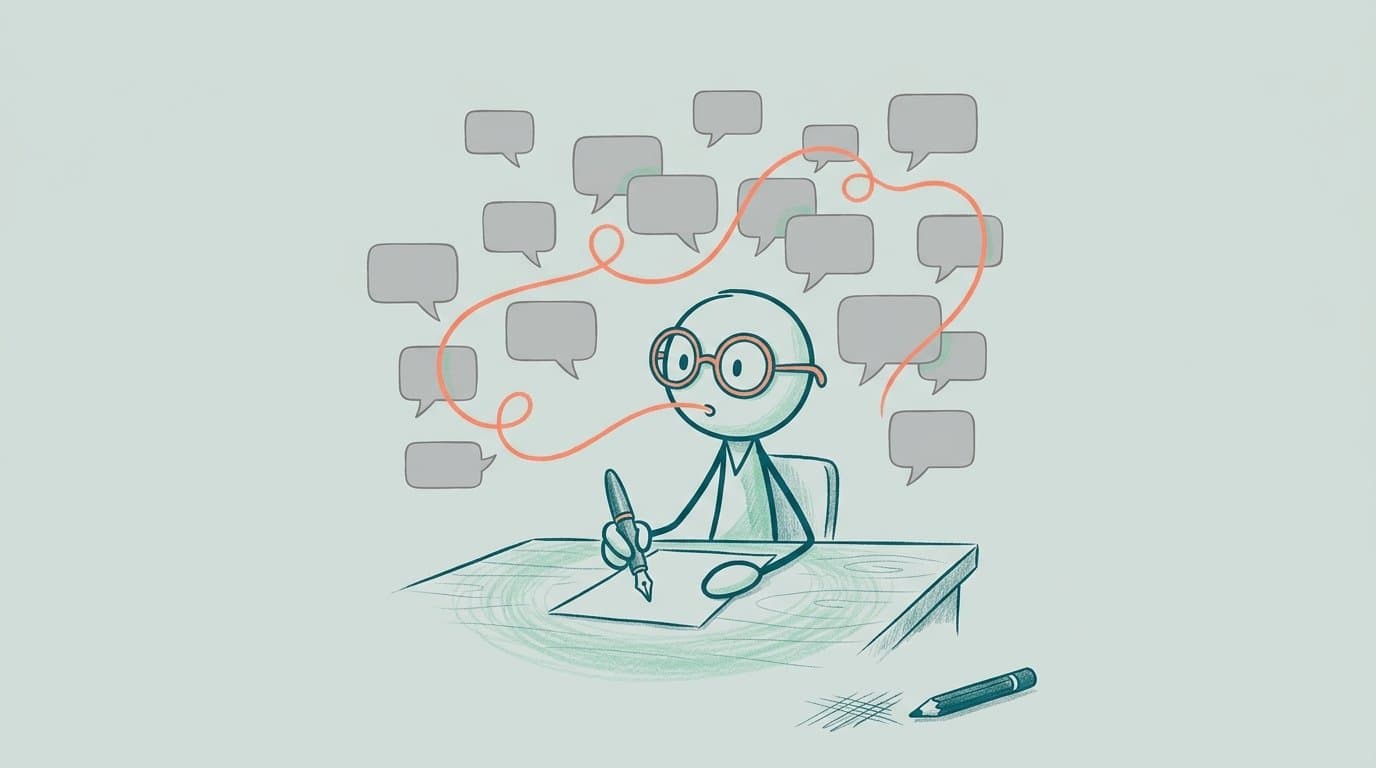
You type a few notes into the AI assistant. Bullet points in, draft out. Then you read it and think: correct, polite, clean. And it doesn’t sound like me at all. The text isn’t wrong. It just belongs to no one. It sounds like a friendly temp who has never seen your brand from the inside.
Good news first: it’s not your fault, and it’s not a bad prompt. It’s what these tools are built for. And that’s exactly why it’s fixable, in layers, the first of which starts tonight with a pen.
A brand voice with AI doesn’t come from a better tool. It comes from the context you give the model. Many vendors sell you a tool and promise brand voice in three steps. You’ll see in a moment why the default output still pulls to the middle, and you’ll get a vendor-neutral path that starts with a pen instead of a subscription.
Why does AI text sound so generic?
AI text sounds generic because the model is trained on the output that scores best on average. The default is the middle, not your edge.
That’s not an accident, it’s by design. After pretraining, a language model gets tuned again with human feedback. People rate answers, the model learns what lands well. And what lands well with most people is almost always the smooth, polite, middle-of-the-road version. Edges rub people the wrong way, so they get trained out. Researchers call this loss of variety mode collapse: the model retreats to a handful of safe phrasings. You don’t need to remember the term. You only need to know the default output is intentional.
This uniform sound even leaves a measurable fingerprint. A Carnegie Mellon University study, published in 2025 in the Proceedings of the National Academy of Sciences, made it visible. The researchers measured the vocabulary of language models. Instruction-tuned models have a tell-tale signature: ChatGPT uses words like “tapestry” and “camaraderie” about 150 times more often than humans writing in the same genre. Both models had a soft spot for “palpable” and “intricate” (Source: TechXplore / PNAS, 2025). That’s the fingerprint. When you meet a text where something is “palpable”, you know what happened.
Why the default pulls to the middle
Drag the slider. Without context, every brand collapses into the same middle. With context, it fans back out.
In a world that never stops changing, it is more important than ever to grow together.
Do customers actually notice?
Yes, and it costs you. Most people can spot AI text at least some of the time, and a recognizable AI tone lowers trust in the brand.
The numbers are clear. 82.1 percent of respondents can spot AI-generated content at least some of the time, and for younger people it’s over 88 percent. And 40.4 percent think less of a brand that visibly uses AI (Source: Column Five / Hookline, 2025). A 2026 Gartner survey adds to it: half of consumers would prefer to give their business to brands that don’t use generative AI in customer-facing messages, ads, or content (Source: Gartner / BizTechReports, 2026). The trigger is almost always the same: the answer comes too fast, and it sounds too formal or robotic.
This isn’t “sounds a bit off”. This is someone clicking away after three sentences. A generic tone isn’t a cosmetic problem, it’s lost trust before the conversation even starts.
Why is generic AI text your opportunity right now?
Because everyone is producing it now. When the average becomes the standard, your own voice becomes the differentiator.
87 percent of marketers now use generative AI in at least one recurring workflow, up from roughly half in 2024 (Source: Skyword / Salesforce, 2026). And everyone produces more, about 42 percent more content per month. When everyone uses the same tool and everyone pulls to the middle, the standard output is no longer an edge. It’s noise.
Once everything sounds the same, the one thing that can’t be copied becomes valuable: that you sound like you. The bigger tool doesn’t win. Not the faster one. The one with the clearest voice. And that’s the advantage of the small.
A solo founder has a handwriting. The big players have an approval committee.
A MarketingProfs analysis puts it the same way: when everything sounds the same, the ability to stay true to yourself becomes the real competitive advantage (Source: MarketingProfs, 2026). What I take from my own work is a conviction: AI should take the dull typing off your plate, so your head is free for what only you can do. Your voice is part of that. You don’t delegate it, you structure it properly.
How do I teach a language model my brand voice?
You give the model the context it doesn’t have. In four layers, from fast and shallow to deep and load-bearing.

Layer 1: Brief better
Most disappointing AI texts aren’t the tool’s fault, they’re the briefing’s fault. “Write professionally about X” gets professional average back. Who is the recipient, what’s the situation, which tone, what has to be in there: the more concrete the briefing, the more it sounds like you. Four concrete before-and-after examples of what such a briefing looks like for an email, a quote or meeting minutes are in “AI for Everyday Desk Work in SMEs”.
Layer 2: Reusable system prompts
Build the good prompt for your most common text types once, cleanly, and save it. Complaint email, quote, status update. The one-time effort becomes a permanent tool. The key is to phrase brand rules as constraints, not as a polite “ideally in our tone”. A model follows clear prohibitions better than fuzzy wishes.
Layer 3: The documented brand core
A model can only reproduce what exists in writing. If your brand core lives only in your gut, you’re building a system that speaks for your brand without knowing it. Four axes are enough: values, a contestable claim about the world, posture, and most importantly an anti-definition, what your brand explicitly never says. The practical punchline: a good list of prohibitions makes AI text better immediately. Not because the model knows more, but because it knows what to avoid. How to write down those four axes without building an 80-page PDF, I laid out step by step in “Documenting Your Brand Core: The Four Axes”.
Layer 4: The brand voice engine
For those who get serious, the document becomes a system: the brand core runs as structured context into every AI output automatically. Email, service, newsletter then sound like one brand, not three acquaintances. This is the layer where AI works in the spirit of the brand instead of as a faster wrapper around a language model.
You don’t have to start at layer 4. You only have to stop standing at layer 0 and wondering why it sounds generic.
Where do you start?
AI text sounds generic because it’s built for the middle. Your brand sounds like you because you give the system the context it doesn’t have on its own. Start tonight with a single list: three phrases your brand would never use, even if they convert. That’s the beginning of your anti-definition. A pen is enough.
If you want to know whether your core is already documentable or still stuck in your gut: the two of us find that out in a 60-minute walkthrough for 99 euros, along the four axes. No pitch, work on the core. If it turns out the core isn’t there yet, that’s an honest answer too.
And there’s a reason this work pays off twice right now: your audience is no longer only human. People increasingly ask an AI assistant for a recommendation, and a model can only pass on what it can clearly place. If your text sounds like everyone else’s, it has no profile of you: nothing to recognize you by, nothing to name you for. A documented core gives your text that recognizable profile. That’s the next stage, and it starts with the same pen.
Related to This Topic
Get the free Getting Started Guide: 10 concrete ways to start using AI productively tomorrow.
Did this article spark an idea? Let's find out which Sinnvampire can disappear for you.