 software-architecture.ai
Human Attention is All You Need: The Productivity Paradox of the AI Era
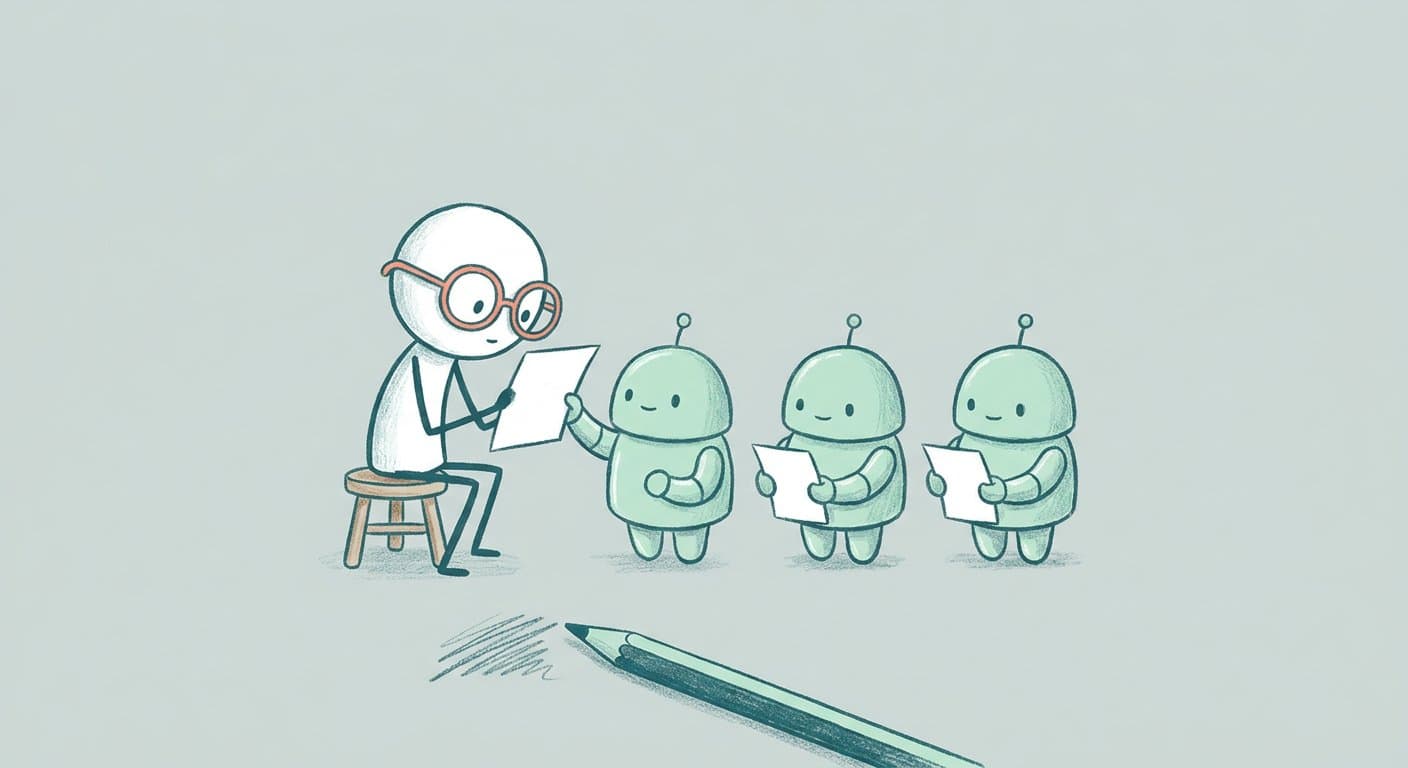
A good ten years ago, in the cognitive psychology lab at Paderborn University, I built the software that measures how scarce and precious human attention is. Attentional blink. Change blindness. Prior entry. What sounds like abstract theory to most people was parameter lists to me.
Today I build the systems that consume exactly that attention.
I am telling you this because that contradiction is the most honest frame for this article. It is where the productivity paradox of the AI era sits: execution gets drastically faster, and yet the day does not feel lighter. The good news: that is not on you, it has a structure. And once you know the structure, you can work with it. What you look at is becoming the most important decision you make.
In 2017, a paper appeared with the title “Attention is All You Need” (Source: Vaswani et al., 2017). It explains why transformer architectures work: no sequential processing of words, but a mechanism that directly weights relevant connections. That paper started the current AI era. What Vaswani did not write into the abstract: the paper also describes the world.
Abundance of information makes attention scarce
Herbert Simon saw this in 1971. “A wealth of information creates a poverty of attention” (Source: Herbert A. Simon, Designing Organizations for an Information-Rich World, 1971). That talk founded what is now called the attention economy. The insight is counterintuitive: it is not the overflowing resource that becomes valuable. It is the resource that disappears because of it. There used to be too little information. Then there was too much. What is too little now: the time and energy to follow it.
Simon said something else that gets quoted less often: the engineers of his time framed the problem as information scarcity, and so they built systems that produce, aggregate, distribute. Systems that flood. The way I read it, that was not a footnote. It became the architecture of the next five decades.
The business model is older than the internet
Tim Wu showed in “The Attention Merchants” that the business model is not new. In 1833, Benjamin Day founded the New York Sun. Price: one cent, far below production cost. Financed by advertisers paying for access to the readers (Source: Tim Wu, The Attention Merchants, 2016). Free content in exchange for attention, attention sold on. The big social media platforms run the same model today.
What AI changes about this model: not the model. The sharpness of the weapon. Targeting that used to work on demographic segments now works on individuals. Organic click-through rates for queries with AI summaries dropped from 1.41 percent to 0.64 percent within a year: the summary intercepts attention before it lands anywhere (Source: Seer Interactive, 2025). For content ranking first in search results, the click loss caused by AI summaries has reached 58 percent (Source: Ahrefs, 2025). Competition for attention does not soften as AI gets better. It gets more precise.
That is the outside: markets harvesting your attention. The inside is newer, and it affects everyone working with agents. Because your own systems consume your attention too. That is exactly where the paradox emerges.
What is the productivity paradox of the AI era?
The productivity paradox: execution gets drastically faster, but the day does not feel lighter. Because the bottleneck does not sit in execution. It sits in attention.
In 2025, the research organization METR tried to measure the AI speedup cleanly. 16 experienced open-source developers, on average five years of experience in their own projects. Before the study, they estimated AI would make them 24 percent faster. Afterwards, they felt 20 percent faster. Measured, they were 19 percent slower (Source: METR, 2025). The gap between perception and measurement was the real finding.
And then the story gets really interesting. METR wanted to repeat the study with newer tools. The experiment stopped producing reliable results. Not because the method was bad, but because people no longer play along: fewer and fewer developers are willing to work without AI. Even for 50 dollars an hour (Source: METR, 2026). METR itself now considers it likely that today's tools genuinely speed developers up. That is not a research failure but the result: a study about working without AI fails because hardly anyone is willing to work without AI anymore.
I can confirm this from my own work. I have moved my entire way of working to agentic workflows. What used to be an afternoon is now one pass while I am already thinking about the next problem. From where I stand, 20 percent is missing zeros. (That is a feeling, not a measurement. And that gap is exactly what this article is about.) Which is why the question is so interesting: if execution has become so much faster, why is my day fuller than ever?
Why don't eight agents make you eight times faster?
Because every real judgment call has to pass through you. The speedup is capped by the serial fraction of your work. And the serial fraction is your judgment.
Python can spawn as many threads as you like. But classically, they all need the same lock, the Global Interpreter Lock. There is exactly one. Everything that wants to compute has to pass through it. (Python, by the way, is currently getting rid of its lock. I am not getting rid of mine.)
In a multi-agent setup, I am the lock. The agents run in parallel. Every real judgment, every decision that needs actual architectural understanding, has to pass through me. Amdahl's law says: the speedup from parallelization is capped by the serial fraction. The serial fraction in agent work is judgment.
Spawning eight agents does not make my work faster. It makes the queue in front of me deeper.
The Amdahl paradox: how much does one more agent buy you?
Drag the slider. Watch how early the real speedup flattens while the queue keeps growing.
Ceiling at this share: 3.3x
That explains the apparent contradiction: more done than ever, and still no air in the day. Those are not opposites. Looked at soberly, they are the same state: a serial processor at one hundred percent utilization. Not a reason to worry, but a reason for architecture. Because a structural limit can be moved once you know where it sits.
Microsoft Research surveyed knowledge workers in 2025 on what this state does to their work: generative AI shifts the cognitive effort from producing to evaluating. Verification is no longer a side process. It is becoming the primary workload (Source: Microsoft Research / IIL, 2025). I wrote about the decision side of this load in “Decision Fatigue in the AI Era”. What shows up there as tiredness after a hundred micro-decisions is the structural pattern behind it here.
This phase, where execution gets cheaper but attention still has to be split between goal and path, is not a transition problem. It is the core problem of the coming years. I wrote a whitepaper about it and call this load the Oversight Tax: what it costs to have to check every AI output before you can trust it.
What happens when execution truly becomes a commodity?
Then the share of attention that goes into the path falls away. What remains is attention on the goal. And it becomes more important, not less.
Now comes the point I actually want to make. You could think: if AI takes over execution, attention becomes less important. The work runs anyway. Why would attention get scarcer?
Because the share of attention that went into the path disappears. What remains is attention on the goal. Purer. More direct. Who I am, what I look at, which world I imagine. That is not a softer topic. It is a sharper one.

Execution was always the detour between intention and effect. The carpenter had to work the wood. The programmer had to write the code. Intention alone moved nothing. When execution becomes a commodity, the detour shortens. Attention on a goal starts having direct consequences. Not magically. Structurally.
The generation that will no longer understand this
I am a millennial. I can imagine what it was like to be unreachable. Not well, but I can imagine it. What I cannot imagine, not really: walking to the next village to tell someone something. The idea is not uncomfortable. It is absurd.
For the generation growing up right now, manual execution work will feel the same way. Not: “that is inefficient.” But: “why did people do that themselves?” For them, directing attention at a goal is the primary form of agency. AI executes. The human aims.
The word “manifesting” sounds esoteric. I use it anyway, because structurally it describes the right thing: when you look clearly at a goal and have systems that execute, the distance between intention and result shrinks. That is not positive-thinking rhetoric but Amdahl's law, applied to intention.
Who wins?
Not the person with the best tools. Tools become commodities. The winner is whoever knows what they are looking at.
In practice that means: the lever is not switching on even more agents. It is keeping the serial fraction small. Building systems so that less has to pass through you. I described the structural path in “When Humans Become the Bottleneck”: organizing knowledge so agents need fewer follow-up questions. And pointing the rest of your attention not at the path, but at the goal.
I am currently building the tooling for this second phase. Not because I am certain it will come. But because I live in the first phase every day and know what it costs when attention still has to be split between path and goal. When the path falls away, something very clear remains.
The paper that started this era is called “Attention is All You Need”. Vaswani probably had no idea how right he was.
Related to This Topic
Get the free Getting Started Guide: 10 concrete ways to start using AI productively tomorrow.
Did this article spark an idea? Let's find out which Sinnvampire can disappear for you.