 software-architecture.ai
Decision Fatigue in the AI Era: Staying Clear as a Mini-CEO of Your Agents
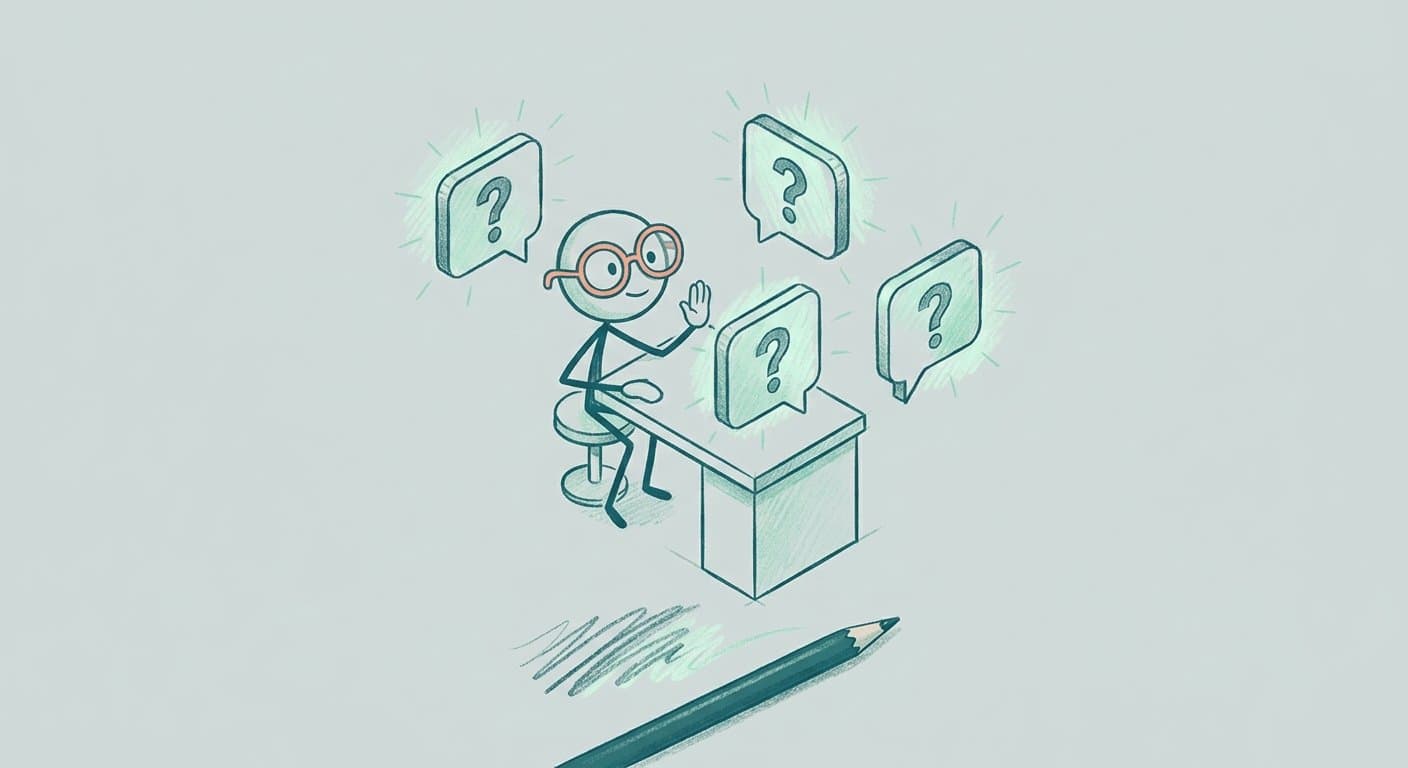
Do you know that feeling when the day is already tired before it has even begun?
9:14 a.m. Three tabs open, an agent running in each one. The first one drafted the weekly report and asks: “Should I send this to clients as is?” The next has a pull request ready and wants your go-ahead. The third has prepared three response options for a customer complaint and is waiting for you to pick.
Seven decisions. Before the first coffee is cold. And that is just the start.

We are all turning into mini-CEOs. Not because we planned it, but because working with agents does exactly that to us: it turns us into people who decide, approve, prioritize, and correct all day. Just without the thirty years of CEO experience that would help us not burn out doing it.
The good news: the knowledge of how to stay clear-headed as a CEO has been around for decades. We just need to translate it to our microcosm.
What is decision fatigue, exactly?
Decision fatigue describes the phenomenon that the quality of your decisions drops after making many decisions in a row. Social psychologist Roy Baumeister described it in 1998. His finding: willpower and decision-making draw from the same finite mental resource. The more you decide, the worse you decide (Source: PMC / NCBI, 2018).
Baumeister’s model is contested. The replication debate around “ego depletion” has been going on for years. But the phenomenon of decision fatigue itself is recognized even by the critics. The exact mental mechanism is up for debate. That worse decisions come out at the end of a long decision day is not.
Researchers at Cornell University estimate that adults make roughly 35,000 micro-decisions per day. Over 200 of those are about food alone (Source: Kai Blog / Cornell, 2026). For executives, the number of high-stakes decisions explodes. According to Harvard Business Review, a CEO makes an average of 50 truly high-stakes decisions per day (Source: Percolator / HBR, 2025).
A University of Cambridge study shows that 60 percent of executives display measurably impaired judgment after prolonged decision-making sessions. That leads to strategic and communication errors (Source: University of Cambridge / Percolator, 2025). That is more than half. After a normal decision-day, you make decisions that are worse than the ones you would make rested in the morning. And you rarely notice it.
I described the psychological mechanics behind this in detail in “Head clear, business runs”. What applies there to self-employed people without an AI context does not get more relaxed with agents. It gets more urgent.
Why does decision fatigue hit mini-CEOs harder than classic CEOs?
Classic CEOs delegate roughly 90 percent of their decisions. Mini-CEOs with an agent army decide 100 percent directly, with no filter. That is the difference, and that is exactly where the new exhaustion comes from.
What actually happens when I work with agents? On the outcome side, the agents do the work. They write the code, pull the data, draft the email. But on a level we have long overlooked, the work does not get less. It shifts. From typing to deciding. I took apart why this bottleneck is structural, and what Amdahl's law has to do with it, in “Human Attention is All You Need”.
Picture it this way: you used to code yourself, write yourself, do the research yourself. Now the agents handle exactly that executional work. That is the point. You delegate the craft side of the work, and it actually works surprisingly well.
What stays entirely with you, though: the alignment with the plan. The quality check. The sense of whether a piece of copy hits the right tone, whether a refactor fits the architecture, whether the response to a customer really lands. Especially in the more creative areas like copywriting, this gets dense: you have to say of every draft whether it feels right. And that is what wears you down. Typing was not what was exhausting. The judging is.
The math behind it is simple. Old way of working: you type a text. 30 minutes of focus work. One conscious decision. Most of the time is execution. Agentic: you brief an agent in 2 minutes. It delivers in 5 minutes. You review for 3 minutes and decide: good, change, different. Then the next agent. And the next. Where you used to make maybe 8 micro-decisions in two hours, now you make 40. The number of conscious decisions per hour rises dramatically.
The Human Clarity Institute asked 503 people about this in 2025. 82 percent use AI tools at work. 43 percent say constantly checking whether what the AI spits out is actually right costs them their focus. 32 percent find it tiring to keep rewriting prompts until the answer fits. Anyone who has both feels it twice: 52 percent in that group report prompt fatigue (Source: Human Clarity Institute, 2025).
That is new. This kind of fatigue did not exist in this form two years ago. We are collectively building a new class of cognitive load. And that in a world that is already exhausted: the Microsoft Work Trend Index 2025 found that 80 percent of the global workforce say they lack the time or energy to do their work. 48 percent of employees and 52 percent of leaders experience their work as chaotic and fragmented (Source: Microsoft Work Trend Index 2025 / Special Report “Breaking down the infinite workday”, June 2025).
We are not rested and relaxed when we start working with agents. We are already exhausted. And the agents demand input constantly.
You are not overwhelmed. You are just not yet organized.
What if the problem is not that you make too many decisions? But that you make all of them on the same level?
Anyone who has been a CEO for thirty years has learned one thing: 90 percent of my decisions are routine. I delegate them. Or do not make them myself. Or automate them. Only 10 percent are the ones where it really comes down to me. For those 10 percent I keep bandwidth free.
Those of us growing into the agentic world do the opposite. We treat 100 percent of the agent requests the same way. Every question with full attention. Every suggestion with the same scrutiny. That is like a new CEO answering every email personally on day one.
No wonder your head is full.
Decision fatigue is not a character problem. It is an architecture problem.
Three categories as default
Three things have become important to me through my own work with agents, and that is my personal perspective, not a study finding: you need a decision architecture that filters. You need defaults that categorize. And you need bundling that only puts in front of you what truly deserves a decision.
Sounds like work. It is. But only once.
How do you build a decision architecture that holds?
Four levers I work with and recommend to clients. They reinforce each other. You do not have to introduce all of them at once, but each one on its own measurably reduces the decision load.
I have written about the organizational side of this bottleneck logic in “From agentic coding to agentic organisation”. What applies there to entire teams applies on a smaller scale to every single person working with agents.
1. Categorize decisions instead of grinding through them
The most important question to ask yourself with every agent request is not “what is the right answer?” but “which category does this decision fall into?”
One thing up front: cost here does not just mean time or money. A weak email to a customer barely costs minutes, but in the worst case it costs trust, reputation, and relationship. That never shows up in a time tracker, but it is the most expensive thing that can happen to you.
Three categories I work with:
- Reversible and cheap. Example: smoothing the tone of an internal note, summarizing a meeting transcript, cleaning up code comments. Stays in-house, no one outside reads it. If wrong, it costs little. Default: agent decides on its own, I spot-check only.
- Reversible but expensive. Example: a larger code refactor, a new customer email sequence, a proposal, a social post. Anything that goes outside or touches trust lands at least here. If wrong, fixable, but it costs time, nerves, and potentially brand perception. Default: agent proposes, I decide actively and look closely.
- Not reversible. Example: sending a contract, writing to production databases, a termination or complaint response to a real customer. Once it is out, it is out. Default: human always, manually. With full attention.
A rule of thumb that helps me: as soon as someone outside your team reads the result, it is at least category 2. Especially on the customer side, you want human-to-human communication, even when an agent has prepared the draft. The final eye is yours.
Once you have defined these three categories cleanly for your everyday work, a large share of your decision load falls into category 1. You do not have to carry that yourself anymore. That is the same trick classic CEOs use. They just have decades of practice categorizing decisions automatically. We are doing it consciously now.
2. Defaults and policies instead of case-by-case decisions
The Microsoft New Future of Work Report 2025 makes an important point: when humans can choose when to delegate to AI, that improves their decisions, provided the AI accounts for that selective delegation (Source: Microsoft Research, 2025).
Concretely: build policies. Not vaguely. Concretely and in writing.
- “Emails to clients with order value above 10,000 euros: always manual.”
- “Code reviews on internal tools: agent commits directly, I review weekly in batches.”
- “External outputs (LinkedIn, blog): always with a human final pass.”
Policies are what classic CEOs call a “delegated authority matrix.” We need the same thing, just for the human-to-agent relationship. If you have made a decision the same way three times, that is a policy. Write it down.
3. Let your agents summarize instead of answering every question one by one
This is the biggest lever. Instead of being bombarded by four agents in parallel, you build a supervisor agent in between. It bundles, prioritizes, and only puts in front of you what truly needs a decision.
That is exactly the principle from the DevOps world being deployed against alert fatigue. On IT teams that get bombarded with thousands of alerts per day, AI now helps filter the noise. Almost 90 percent of security operations centers are overwhelmed by false positives (Source: Osterman Research / Dropzone AI, 2025).
Multi-agent orchestration with a clear hierarchy demonstrably reduces hand-offs by 45 percent and accelerates decisions by a factor of 3 (Source: IBM Research / onabout.ai, 2025).
Researcher Margaret Storey, who works extensively on software engineering productivity, puts it well: “Adding more agents to a project may add more coordination overhead, invisible decisions, and thus cognitive load” (Source: Margaret Storey, 2026). More agents do not automatically make it better. Only the right orchestration does. The trick is not to switch on more agents. The trick is that only one of them talks to you.
4. Protected decision slots
Make important decisions in the morning, when bandwidth is fresh. Routine in the afternoon. No important client emails at 6 p.m. after eight hours of agent sessions. Sounds banal, but that is exactly what 60 percent of executives report: after long decision sessions, quality drops measurably (Source: University of Cambridge / Percolator, 2025).
And: some decisions the agents should not even raise. If your agent asks you for decision Y at time X, you can often just say: “Collect it. We will look at it tomorrow.” Not everything has to be decided right now.
What comes after the first weeks with agents?
In the next two years, most of us will work with agents. Some will shape the move into the mini-CEO role consciously and draw energy from it. Others will slide into decision fatigue and abandon AI again, arguing that AI is “not for them.” The difference is not in the AI. It is in the architecture around it.
You do not become CEO because you planned it. You become CEO because agentic work pushes you there. Once you understand that, you can equip yourself accordingly. Before exhaustion makes the choice for you.
If you are noticing right now that you are in exactly this phase: the agents work, you decide, the day feels differently tired than it used to. The next step is not to switch on more agents, it is to build your decision architecture. You can tackle that alone or sort it out together in coaching.
Sit down. One hour, one pen, one blank page. Which decisions do you keep making the same way? Which fall into which category? Which ones do you not want to make yourself from today on?
One hour. That is all the start needs.
Related to This Topic
Get the free Getting Started Guide: 10 concrete ways to start using AI productively tomorrow.
Did this article spark an idea? Let's find out which Sinnvampire can disappear for you.