 software-architecture.ai
Agentic Organization · Leadership
Agentic organization:AI agents as employees,and who answers for them
Three questions nobody asks in the stand-up
- 01Who is accountable when the agent makes a mistake?
- 02How do you onboard someone who never clocks out and never learned where the coffee machine is?
- 03And what do you actually tell the six people in the room?
Monday, 8:30 a.m., stand-up
Six people, one screen. On it are two lines no one in the room wrote. The invoice agent reports 214 receipts matched. The support agent reports 41 tickets sorted, three of them marked “unsure, please check”.
The scene is a thought experiment. Assume for a moment that a quarter of your workforce are AI agents as employees that carry out tasks on their own, start to finish. Today, according to Bitkom, 11 percent of German companies that use or plan to use AI run agents like this. Tech startups average twelve employees, and nearly half of them already use such agents.
Team board
Anna
Writes quotes
owned by
Anna
Mehmet
Plans jobs
owned by
Mehmet
Julia
Advises clients
owned by
Julia
Tobias
Tech and IT
owned by
Tobias
Sina
Bookkeeping
owned by
Sina
Paul
Purchasing and stock
owned by
Paul
Lena
Matches receipts
owned by
Lena
Jonas
Sorts tickets
owned by
Jonas
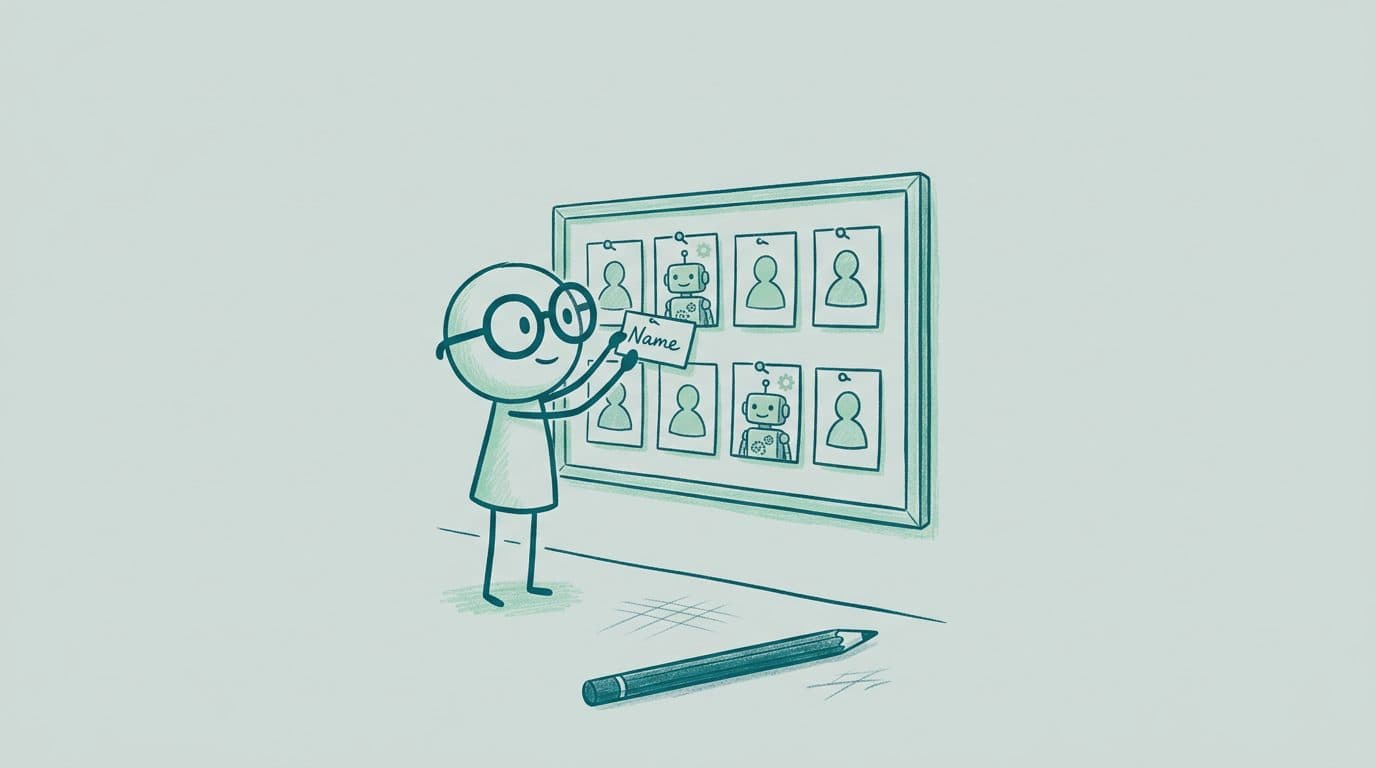
That raises a leadership question. In a business with eight positions, the answer starts with a table and a conversation.
An agent is a position. And every position has a person who answers for it.
01
How many companies already use AI agents?
11 percent of companies that use or plan AI. But almost every second tech startup, and those average twelve people.
I have worked with AI agents since they first appeared in software development. Today, I work with a whole fleet of them. At some point you notice you are no longer operating tools. You are answering for a position. So how far along are other businesses?
The latest German figures come from Bitkom, the German digital industry association: September 2026, representative, 603 companies with 20 or more employees. 57 percent of all companies now use AI. A year ago it was 36, two years ago 20. Of those that use or plan AI, 11 percent already run agents, 29 percent plan to, 31 percent are discussing it. For only 24 percent it is not on the table (Source: Bitkom, 2026). And zero percent say they get the full potential out of AI. 59 percent say: not at all.
Bitkom president Ralf Wintergerst puts it this way: AI agents today are roughly where AI as a whole was three years ago. The same release also says an agent that acts on its own needs reliable data, connected systems, and rules about what it may and may not do.
Startups look different. In a Bitkom survey of 102 tech startups from July, more a mood check than a representative sample, 48 percent use AI agents. 65 percent build their own AI applications, and not a single one goes without AI (Source: Bitkom, 2026).
McKinsey looked at this internationally. Large corporations are now scaling agents at 40 percent, up from 27 the year before. Smaller companies remain flat at 22 percent ( Source: McKinsey, 2026 ). The gap is growing, even though small businesses could benefit greatly. A single agent can already carry a noticeable share of their work. “Smaller” at McKinsey, though, means under a billion dollars in revenue. A twelve-person business barely shows up in that statistic. So translating the frameworks of the big players down to your size is up to you.
To be fair, the 11 and the 48 percent cannot be compared directly. One is representative of businesses with 20 or more employees, the other a snapshot of an industry built around software. The startups offer a glimpse of where the market is heading. Adoption could move quickly: Wintergerst expects agents to spread much like AI overall, which rose from 20 to 57 percent in two years.
This spring, I argued in “From Agentic Coding to Agentic Organization” that AI should flow through every part of a business like electricity, reaching far beyond development. This article picks up one step later: the agents are already at work, and someone has to lead them.
Companies using or planning AI
Tech startups
Two different bases: the top bars cover companies using or planning AI; the bottom bar covers 102 tech startups as a snapshot. The bars show a direction, not a like-for-like comparison.
Bitkom, 603 companies with 20+ employees, Sept. 2026 · Bitkom startup survey, July 2026
02
Do you lose people when agents join the team?
In startups, mostly not. The next hire just turns out to be a person less often.
Back to the opening stand-up. When two agents handle a quarter of the work, the six people in the room naturally wonder what that means for their own job. That question deserves an honest answer, and the startup numbers help.
In August, Bitkom asked tech startups what AI had done to their headcount over the past twelve months. 27 percent skipped a new hire because of AI. 7 percent cut positions. 16 percent hired additional people because of AI. For 50 percent: no effect (Source: Bitkom, 2026). The average startup has 12 employees and one open position. A year ago it was 13, in 2024 still 15 (Source: Bitkom, 2026). And 62 percent expect headcount to grow this year.
In practice, a quarter agents rarely comes from layoffs. It comes from the next position never being advertised. The company grows in tasks, not in heads.
If you are still considering layoffs, bear Gartner’s forecast in mind: by 2029, 30 percent of employees laid off because of AI will need to be rehired, often at a much higher cost ( Source: Gartner, 2026 ). Cuts bring quick money, but they drain the talent pipeline and take knowledge with them that lives in no system. Gartner analyst Tori Paulman says the biggest mistake of the early AI era will have been “believing that work automation was the point, when workforce amplification was the opportunity.”
For the team from the stand-up, that means the two agents can give the six people time again for customer conversations. For proposals someone actually read. For the work they joined your company to do. Nobody joined for the joy of matching receipts.
- 50 % no effect
- 27 % skipped a new hire because of AI
- 16 % hired additionally because of AI
- 7 % cut jobs
Gartner, Sept. 2026: 30% of people laid off because of AI will have to be rehired by 2029.
Each square is one percent of the surveyed tech startups, effect over the last twelve months.
Bitkom startup survey, Aug. 2026 · Gartner, Sept. 2026
03
Who is accountable when an AI agent makes a mistake?
Always a person with a name. The machine cannot be.
For a 2026 study, Deloitte asked executives about agents in the workplace. One finance executive says it plainly: “The machine will never be accountable” (Source: Deloitte, 2026). Accountability is the dimension most likely to be overlooked, Deloitte writes. Almost 70 percent of respondents name the inability to trust and govern agents as a major barrier (Source: Deloitte, 2026).
91 percent of AI investment goes into technology infrastructure, 7 percent into work and people (Source: Deloitte, 2026).
91 %
into technology infrastructure
7 %
into work and people
Share of organisational AI investment. The thin grey remainder: other.
Deloitte Insights, 2026
Since July, Microsoft recommends governing agent identities exactly like employee identities. They name three problems. Agents pile up access rights and keep them forever. When an agent acts on its own, nobody is accountable. And managing all of it by hand does not scale. Their answer: every agent gets a “named sponsor”, a person who answers for the agent’s access and lifecycle, renews it, or shuts it down (Source: Microsoft, 2026).
In April, Gartner published six steps against “agent sprawl”: governance rules, a central agent inventory, identity and lifecycle per agent, rules for data access, monitoring behavior, culture (Source: Gartner, 2026).
Gartner designed these steps for organizations running hundreds of agents. Applied to a small business, they fit into a single table. I take the term sponsor a little further than Microsoft does. There, the sponsor answers for access and lifecycle. In a small business, the same person is also accountable for what the agent does. Several people may work on an agent. One person carries responsibility: one name per agent. The inventory is the table itself, one row per agent. Identity means: the agent has its own account, not yours. Lifecycle means: a review date and a stand-in for when the person responsible goes on holiday or leaves the company. Data access lives in the “may and may not” column. Monitoring and culture do not fit into a column. They are what the next two sections are about.
An agent without a sponsor is a temp nobody hired. With access to the books.
The machine will never be accountable.
04
Which roles do people need in an agentic organization?
Three: designer, controller, auditor. In a small business these are three hats, not three jobs.
Giving each agent a name makes accountability clear. One question remains: what does that person actually do? In an interview series published by Snowflake, a head of data and AI from healthcare tech describes three roles above every agent (Source: Snowflake, 2026).
Designer
Builds the process and the agent that runs it. Decides what the agent may do.
Controller
Watches execution and reviews the output. For the support agent from the stand-up, that means reviewing the three tickets marked “unsure”. The other 38 go through without review.
Auditor
Vouches independently for the agent’s work where the stakes are high. Pulls a random case and looks at it from scratch.
She also says this: doing the task yourself may become optional, even a hobby. But human accountability does not go away. She calls the gap between “we have agents” and “we employ agents well” a management gap.
Large organizations build whole departments for these three roles. In a business of eight, they are three hats shared by two or three people. Designer and controller can be the same person: whoever built the agent knows it best and checks it daily. I always give the auditor hat to someone else, because self-review tends to confirm what you already believe. With two people, that means one builds and checks daily, the other pulls the samples.
The controller hat takes the most work. It needs daily attention, and small teams quickly run short of that. Why more agents therefore do not automatically lighten your load is something I wrote about in “Human Attention is All You Need”.
Three levels of autonomy
Each of my agents gets one of three levels in its job description. Level 1: may recommend, a person decides every case. Level 2: may act and report, a person sees the log. Level 3: may act, a person sees samples. Plus one rule: level 3 only exists with an auditor. Without a sample, that is no longer delegating.
Friction on purpose
Deloitte warns about people who are only nominally in the loop: they click approve at the end without really looking. Their proposal is called purposeful friction: people step in not as the final stamp, but at the points that need judgment, exception handling, or an assessment (Source: Deloitte, 2026). The support agent that sorts 41 tickets and flags three is built right. The agent that sorts 41 tickets and makes you nod through all 41 at the end is built wrong. The second one costs you more attention than before.
Microsoft surveyed 20,000 knowledge workers in ten countries for the Work Trend Index, Germany included. Only 26 percent of advanced AI users say that agent workflows, handoffs to people, and quality standards are documented and repeatable in their team. Among everyone else it is 19 percent (Source: Microsoft Work Trend Index, 2026). Roughly three out of four respondents work in teams where nothing says where the human takes over.
Onboarding by writing it down
An agent is like an apprentice with a perfect memory. Zero years at the company. It keeps everything you tell it, instantly. But it knows nothing you do not tell it. Not that Ms. Meier (fictitious name) at your biggest client always gets the first call. Not that supplier X’s invoice is off by 30 euros every month and that is fine. You onboard a person by letting them tag along. You onboard an agent by writing things down.
You can draft that job description yourself right below.
Agent workflows, human handoffs and quality standards are documented and repeatable at team level. Roughly three out of four respondents work in teams where nothing says where the human takes over.
Microsoft Work Trend Index 2026, 20,000 knowledge workers, 10 countries incl. Germany
Personnel file
The person who owns this position.
Job description
This position does not exist. Nobody owns it.
Sponsor principle after Microsoft Entra (2026), roles after executive interviews (Snowflake, 2026), translation to small businesses: my own perspective.
05
How does the human team stay healthy?
With trust you can measure, and with slack in the plan.
Trust and AI use go together, and two studies show it independently. Both are correlations, not proof of cause: people who are productive may simply like AI more. In spring, Gartner surveyed 12,004 employees and managers in 40 countries. Employees with a positive outlook on AI are 3.4 times more likely to be highly productive (Source: Gartner, 2026). The main drivers: confidence in one’s own current and future role, and ongoing, open communication about how AI is used and what that means for jobs. Only 27 percent of executives there have a comprehensive AI strategy, only 20 percent think their workforce is truly ready.
Deloitte measures a different pair, with its own method, so the two multipliers cannot be compared: trust in one’s own organization and actual use. Employees with high trust in their organization are 3.8 times as likely to use agentic technology (Source: Deloitte, 2026).
In the Work Trend Index, 81 percent of leaders say they feel safe suggesting new ways of working with AI. Among employees it is 67 (Source: Microsoft Work Trend Index, 2026). “My manager makes room for experiments”: 78 to 59. “Trying new things is rewarded, whatever the outcome”: 21 to 10. Leadership loves the agents. Someone on the team waits to see whether they get the blame when the agent makes a mistake. The name in the table says who cleans up the mistake and teaches the agent what went wrong. Answering for an agent here means fixing and explaining. If an agent’s mistake turns into trouble in the stand-up, nobody will volunteer their name on the board for the next agent.
What happens when output flows into the team unchecked was measured by a team from BetterUp Labs and the Stanford Social Media Lab. 40 percent of 1,150 full-time workers in the US received “workslop” in the past month: AI-generated work that looks like good work but does not move the task forward (Source: BetterUp Labs and Stanford Social Media Lab via CNBC, 2025). 53 percent were annoyed by it, 38 confused, 22 offended. Half of them saw the sender as less capable afterwards. An agent that delivers into the team unchecked does the same thing, only faster. The reputation that takes the hit belongs to the sponsor.
Deloitte also advises leaving enough slack in processes and plans so people can absorb the unexpected. For me that means: whoever wears the controller hat gets hours for it in the weekly plan, not “on the side”. Otherwise friction on purpose turns into an approval click at 5:58 p.m.

Tell people what the agent is not allowed to do. That reassures more than the list of what it can do. In the stand-up, the log sits next to the result. And the person who answers for an agent gets to say when they want it switched off.
3.4×
more likely to be highly productive with a positive outlook on AI
Gartner, n = 12,004, 1Q 2026
3.8×
more likely to use agentic technology with high trust in the organisation
Deloitte TrustID 2026
The two multipliers come from different studies and cannot be compared with each other. They point in the same direction.
Gartner, 12,004 employees, 1Q 2026 · Deloitte TrustID 2026 · BetterUp Labs / Stanford Social Media Lab, 2025
06
Where do you start on Monday?
With a table and a stand-up. You already have both.
Whether you plan to introduce AI agents or already have some running, start with the table from the accountability section. It has five columns: agent, task, owned by, may and may not, and review date. There is one row per agent. If “owned by” is blank for any agent, you know what to do this week.
Then the stand-up. The agent lines stay on the screen. They are read out by the person who answers for them. “My invoice agent matched 214 receipts, I looked at three, one was wrong, I taught it.”
Gartner expects that by 2028 at least 15 percent of day-to-day work decisions will be made autonomously by agents. In 2024 it was zero (Source: Gartner, 2025). The sooner you add the names, the easier it is to keep track. Today it may be two agents, in a few years a lot more.
If you get stuck on the “may and may not” column: that is where I work with businesses, agent by agent, until every line says what it may do.
All names of individuals and companies used in this article are fictitious. Any resemblance to real persons or businesses is purely coincidental and unintentional. The examples are provided solely for illustrative purposes.
Anna
Writes quotes
Mehmet
Plans jobs
Julia
Advises clients
Tobias
Tech and IT
Sina
Bookkeeping
Paul
Purchasing and stock
Invoice agent · Matches receipts
- owned by
- Sina
- may
- match, flag mismatches
- may not
- post, pay
- Review
- every 90 days
Support agent · Sorts tickets
- owned by
- Julia
- may
- sort, draft replies
- may not
- reply alone, refund
- Review
- every 30 days
Example, fictitious. Six people, two agents, and every agent carries who owns it, what it may do and when someone looks again.
Related to This Topic
Get the free Getting Started Guide: 10 concrete ways to start using AI productively tomorrow.
Did this article spark an idea? Let's find out which Sinnvampire can disappear for you.