 software-architecture.ai
AI in E-Commerce: How a Small Fashion Label Gets Its Processes Under Control
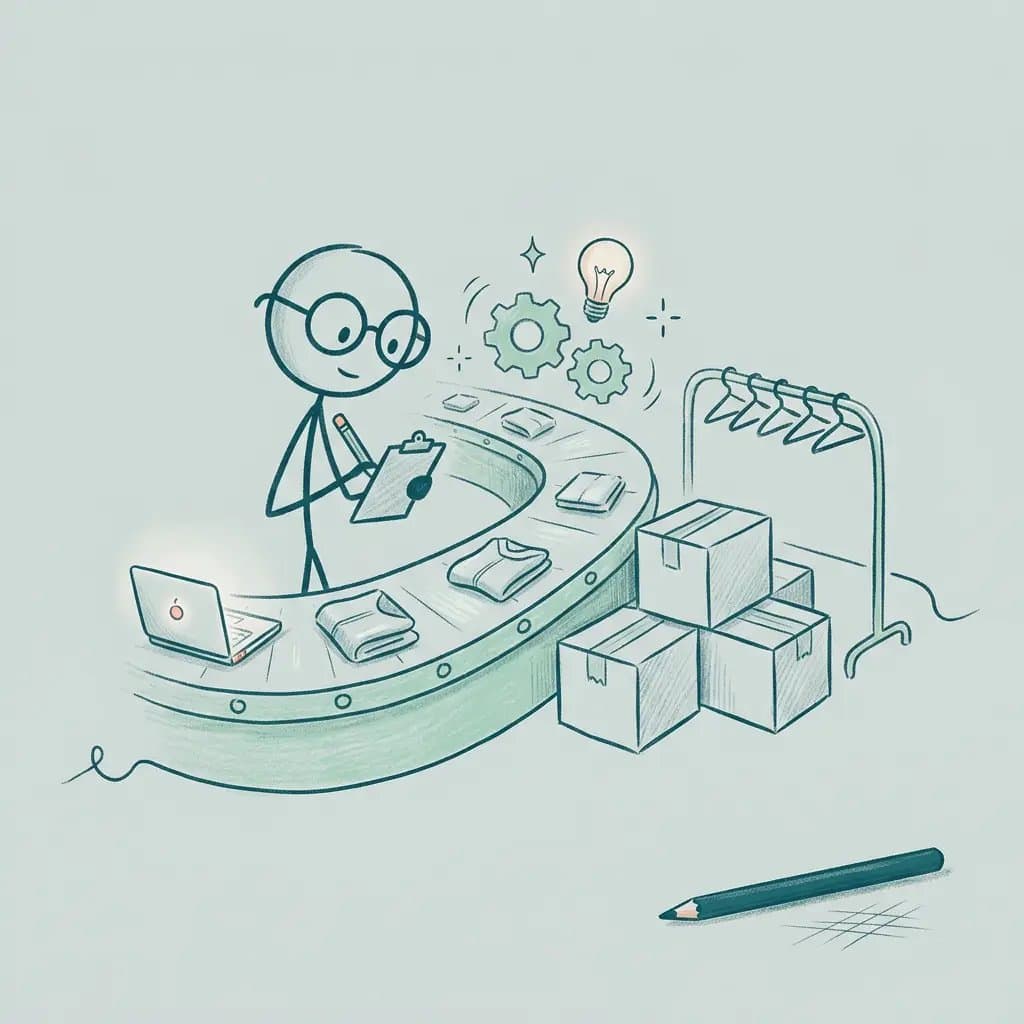
It’s almost midnight when the fortieth DM of the day pops up in the warehouse of a small fashion label: “Do the cargos run large?” Mara (fictitious name) sits between cardboard boxes and types the answer, the same one as in the 39 messages before. Three bags of returns are waiting in the hallway to be checked in the morning.
When people talk about AI in e-commerce, it’s almost always about the sales front: chatbots on the homepage, product recommendations, personalized banners. I look somewhere else first, because as a software architect, I care most about the processes no customer ever sees. And that is exactly where the bigger lever sits for a small shop: product copy, the message flood, returns, restocking. That is where the time goes. And that is where you can get it back.
Mara and her label SASTREE don’t actually exist. I built them as a tangible example: a small streetwear label, six people, grown on TikTok, customers mostly Gen Z. The example is invented. The problem is not. And every market figure I am about to calculate with comes from current studies.
The industry sees it the same way: 61 percent of retail companies say that using AI gives retailers a competitive advantage (Source: Bitkom, 2026). So the question is not really whether AI belongs in a shop like this. It is where to start. And for that, you have to look honestly at where such a shop actually loses time and money.
Where does a clothing shop really lose time and money?
Not in selling. The sales moment itself is one of the few times two people actually meet, and that is exactly where AI has no business being in the foreground. The time gets lost elsewhere: the content assembly line, the message flood, and above all, returns. Behind the scenes, almost everything is open to AI.
Let’s start with the biggest item. Nothing gets returned like fashion: around 90 percent of all returned items in Germany are fashion, and for 2025 the returns research group at the University of Bamberg expects a record of roughly 550 million returned parcels (Source: Forschungsgruppe Retourenmanagement, 2025).
The EHI Retail Institute surveyed how this plays out for individual shops: one in eight surveyed e-fashion retailers gets more than half of all orders sent back. For almost one in four, the return rate sits between 36 and 50 percent (Source: EHI via TextilWirtschaft, 2025).
And every single one of those returns costs money, even if the return label says “free.” The Bamberg research group calculates an average of 15.18 euros per return once you add up processing and the loss in product value (Source: University of Bamberg).
For SASTREE that means: 900 orders a month, a 35 percent return rate, so roughly 300 returns. Times 15 euros: around 4,700 euros. Every month. Not for fabric, not for marketing. For sending things back. Run this once with your own numbers:
Run it with your numbers
Assumption: 7 percentage points fewer returns through honest size hints
Cost basis: 15.18 € per return (returns research group, University of Bamberg)
The bars show monthly numbers. Multiply by twelve and even a small figure quickly becomes a month’s salary. Smaller shop, no fashion? The returns math is fashion-specific, the content assembly line, the message flood, and restocking are not. Only the order changes, not the logic.
The second time sink is less obvious, but just as stubborn: the content assembly line. Every drop needs product copy, size specs, care instructions, social posts, a newsletter. In two languages, in the right tone, by Friday. That is assembly-line work with brand-voice standards, and it eats exactly the evenings that were supposed to go into the next collection.
How does Gen Z itself use AI when shopping?
A clear majority already shops with AI help: 61 percent of Gen Z shoppers used AI tools to help with a purchase in the past year (Source: PayPal, 2025). The shop they buy from is often further behind.
This is not a US phenomenon. In Germany, 27 percent of shoppers under 29 frequently use a chatbot for product search (Source: Bitkom, 2026). If you sell to Gen Z, you sell to people who already use AI to shop.
The flip side is the interesting part: only about a third of this generation would let an AI make purchase decisions on their behalf (Source: Statista, 2026). This audience has zero fear of the technology and, at the same time, a very fine detector for anything fake. They let AI take over the searching. Not the deciding.
Translated for your shop:
AI belongs on the assembly line. The human belongs at the counter.
Repetitive, measurable, middle-of-the-night work can go to a machine. Relationships, taste, curation: that stays with the brand. And this exact line is easier to draw for a six-person label than for any large company. At SASTREE it is a decision at the kitchen table. In a corporation it is an alignment round across five departments. That line runs through every process below: AI delivers the suggestion or the early warning, the decision itself always stays with a human.

Which processes in an online shop can AI take over?
A small fashion shop can often be broken down into at least four pillars: product copy, message triage, size guidance, and restocking. The same three questions apply to each: What does the AI take over, how do you recognize quality, and where does the human stay.
1. Product copy and content
From cut data, materials, and the label’s existing texts, the system drafts product copy and posts that already sound like SASTREE instead of factory settings. The 30-piece drop no longer needs a weekend marathon, just a morning of polish. Quality bar: Would a regular customer recognize the sender? The human keeps the final version and everything that carries attitude, because that is exactly what keeps the copy from sounding like a language model instead of your label. I’ve written up how to do that step by step in my article on brand voice with AI.
2. Message triage
Factual questions like measurements, delivery time, or order status get answered by an assistant instantly, even at midnight. Anything with emotion, a complaint, or ambiguity lands unfiltered with humans, visibly so for the customer. Quality bar: an honestly measured resolution rate on factual questions and zero automated replies to emotional messages. The community care that made the label big does not get automated away. The 40th DM at 11:40 pm does.
3. Size guidance that lowers the return rate
This is where the biggest money lever sits. The basic idea is not new: larger online shops have used return-based size hints for years. What is new is that it is now affordable for a six-person label too. Two thirds of consumers say they sent fashion back in the past year mainly because it did not fit (Source: Deloitte, 2026). A system that learns from your own return data how each cut runs turns “size M” into an honest hint: “Runs large, many shoppers with your profile keep S.” Assume SASTREE brings its rate from 35 down to 28 percent: that is over 60 fewer returns a month, around 950 euros, plus the saved checking and packing time. What improvement is realistic is something only your own data can tell you. Quality bar: the return rate itself, measured per cut. And the human decides whether a cut gets changed, instead of just improving the hint.
4. Restocking with an early-warning system
The hoodie sells out in week two, while eighty jackets are still sitting on the shelf in November: exactly these moments show up in an analysis before they show up in your gut. Unlike the product copy, there is no language model behind this, just classic machine learning that spots trends in sales and return patterns. What is turning faster than planned, what is sitting, what does the returns picture say about a cut. The system warns early. It doesn’t order. Quality bar: fewer sold-out moments on bestsellers, less clearance pile at the end of the season. The order decision itself stays with the team, because assortment is taste, and taste is the core of the brand.
Add it up and a setup like this can potentially free ten or more hours a week, plus the returns savings. Check the order of magnitude against your own numbers before you plan around it. For what such a weekly calculation looks like in a different setup, see my article on a 10-person company winning back 15 hours a week.
Can AI run your online shop entirely?
No. And that is good news.
Even the most AI-friendly generation does not want a machine deciding for them. Certainly not with fashion, because buying clothes is identity, not logistics. The industry is already talking about “agentic commerce,” AI agents that shop autonomously (Source: Bitkom, 2026). But for a small label, the order of operations is what counts: your own processes first, the future scenarios second.
And honesty belongs in your own processes too: AI systems make mistakes. They need spot checks, clear quality bars, and a human who looks. If you measure, you can delegate. If you do not measure, you are just hoping.
The starting point is one honest week
The strongest AI deployment in a small shop is unspectacular. It produces no show on the homepage, but calm in the warehouse: copy that is done by Friday. Messages answered at midnight without anyone being awake. Returns that never happen in the first place.
Getting started doesn’t take a technology decision. Write down for one week where the hours go. Pick the one process that eats the most. Start there, with a quality bar that tells you what “good” looks like. That is all it takes at the beginning.
And Mara? Back in the warehouse at 11:40 pm, between the same cardboard boxes. This time with a livestream and her community. The size questions were answered long ago. Who answered them was labeled honestly.
All names of individuals and companies used in this article are fictitious. Any resemblance to real persons or businesses is purely coincidental and unintentional. The examples are provided solely for illustrative purposes.
Related to This Topic
Get the free Getting Started Guide: 10 concrete ways to start using AI productively tomorrow.
Did this article spark an idea? Let's find out which Sinnvampire can disappear for you.