 software-architecture.ai
Why AI Fails Without Humans: What Small Businesses Can Learn From the Latest Studies
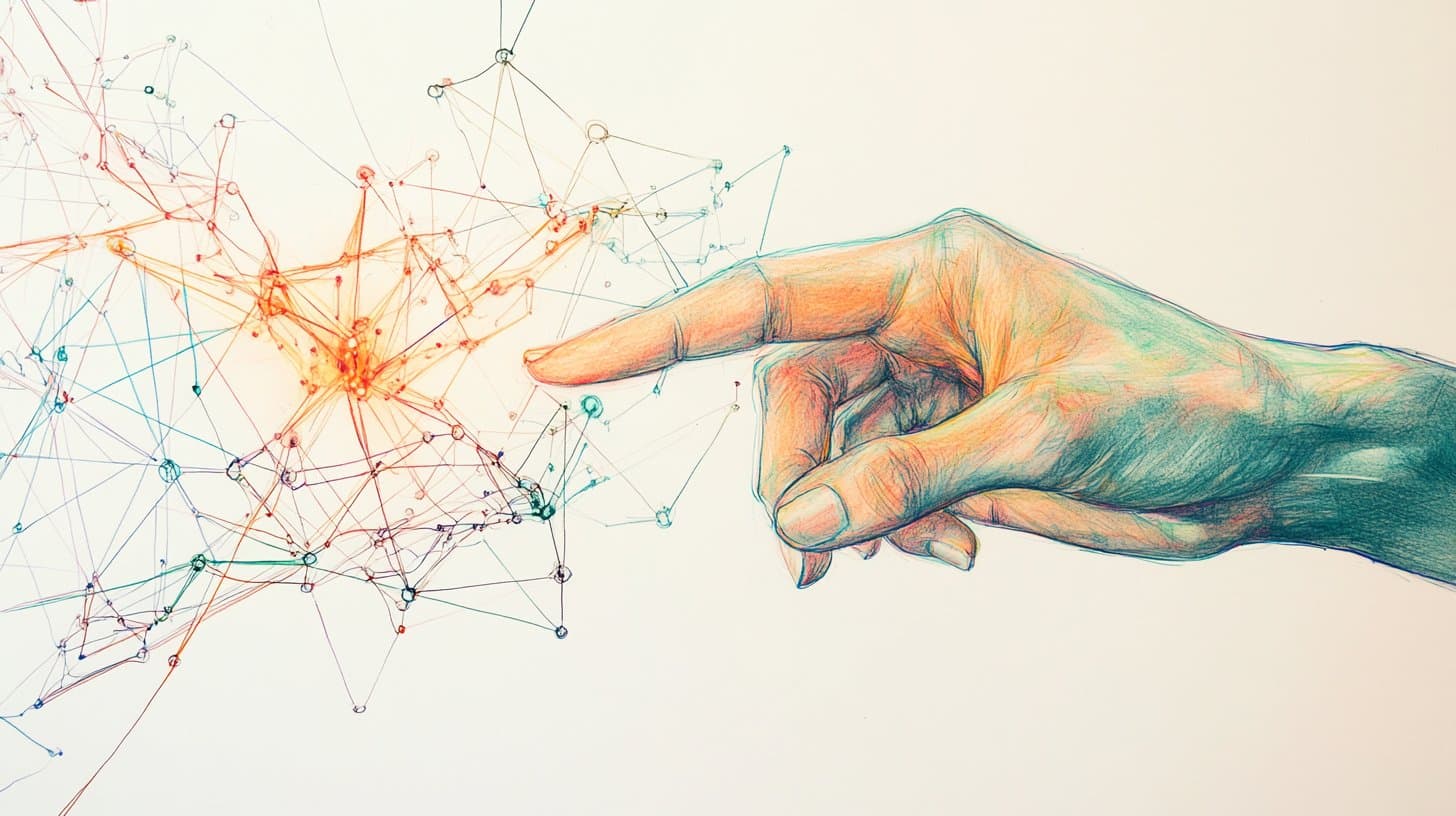
Imagine buying the most expensive tool at the hardware store. A professional CNC milling machine. You put it in the workshop. And then it just sits there. Nobody knows how to operate it properly. The machine is fantastic. But without someone who can run it, it produces scrap.
That’s exactly what’s happening with AI in many small businesses right now. The tools are there. ChatGPT, Claude, Copilot. But the question too few people are asking is: Who’s actually steering this? And how well?
In early 2026, Upwork published their “Human+Agent Productivity Index.” It’s the first data-driven benchmark measuring how humans and AI agents perform together. The result: when AI agents work alone, they fail regularly. But when a human joins in, project completion rates jump by up to 70 percent. Seventy percent. And that’s on simple, well-defined tasks (Source: Upwork HAPI, 2026).
The Labor Market Is Splitting in Two
Harvard Business School published a study in March 2026 showing what happened after ChatGPT’s launch. Two types of jobs have diverged completely. Jobs with “augmentation potential” (where AI supports the human, but the human stays in control): demand has climbed steeply since late 2022 and remains well above pre-ChatGPT levels. And jobs with “automation exposure” (where AI can replace the human): demand has dropped sharply and stayed below earlier levels (Source: Harvard Business Review / HBS Working Paper, 2026).
What does this mean for a small business with 5 or 15 people? The roles you hire for are changing. You don’t need pure data entry staff anymore. But you need people who can steer AI and evaluate its output. The HBS researchers put it this way: “Occupations with potential for AI augmentation tend to involve greater use of social and hands-on technical skills.” In other words: human skills, judgment, social competence.
Think about an accountant who used to spend all day sorting receipts. AI can take over that task. But the accountant who explains to a client what the numbers mean and which tax strategy makes sense: that person is needed more than ever. The routine work disappears. The advisory work becomes more valuable.
The AI Augmentation Scissors
Source: HBS Working Paper via HBR, 2026
The Productivity Paradox
Many people think: “Okay, I’ll just give my team AI tools and things will sort themselves out.” It’s not that simple.
METR, a nonprofit that evaluates AI models, has run an illuminating series of studies on this. In early 2025, their data showed: sixteen experienced open-source developers took 19 percent longer to complete tasks when using AI tools. Those same developers believed they were 20 percent faster. A 39-percentage-point gap between perception and reality (Source: METR, 2025).
Then came the February 2026 update. METR repeated the experiment with newer tools, lower compensation, and a larger sample. And this is where it gets interesting: a subset of the original developers now showed an 18 percent speedup. Newly recruited participants showed a 4 percent speedup. First slower, then faster.
METR even had to change their study design because many developers refused to work without AI. One participant put it this way: working without AI felt like walking across the city when they’d gotten used to taking an Uber. Others admitted they preferentially submitted AI-friendly tasks and avoided ones where they’d have to work without AI.
What does this tell us? It’s not the AI that makes the difference. It’s the person. Those who use AI blindly get slower. Those who consciously choose which tasks suit AI, who critically review results and bring their own context, can become significantly faster. AI is not autopilot. It can make you faster. But only if you know when and how to use it. And especially: when not to.
It’s like GPS navigation. If you know the area, the GPS sometimes slows you down because you’re staring at the screen instead of just driving. But in an unfamiliar city, it’s invaluable. The tool itself is neither good nor bad. What matters is whether the person behind it knows what they’re doing.
Skills Shortage Meets AI Competency Gap
Germany has a double problem. First: a skills shortage. A 2026 KOFA study shows that 58 percent of SMEs expect serious difficulties filling positions in the next five years. A third even see their existence at risk (Source: KOFA, 2026). And second: even the people who are there often don’t use AI effectively.
According to a collection of studies compiled by Maximal Digital, only 28 percent of SMEs have a change management strategy for AI adoption. Two-thirds, 67 percent, report resistance from employees toward AI (Source: Maximal Digital, 2025). Meaning: even if you buy the tools, if you don’t bring your team along, it doesn’t help much.
The good news: Germany’s Institute for Economic Research reports that 82 percent of companies already see productivity gains from generative AI, averaging 13 percent per year (Source: IW Cologne, 2025). Those who get it right benefit enormously.
For a small business, this means something very concrete: you can’t solve the skills shortage by just buying AI and hoping it replaces the missing people. But you can use AI to level up your existing team so that ten people do the work of 13 or 14. Not by working harder, but by eliminating routine work so they can focus on what only humans can do.

What AI Cannot Do
There are three things AI cannot do today and won’t be able to do for the foreseeable future. And they happen to be the three things that make all the difference in business.
Judgment in Context
AI can generate ten options for you. But it doesn’t know which one is right for your business, your customers, your situation. That requires someone who understands the context. And “context” isn’t something you can pack into a prompt. Context is the sum of years of experience, industry knowledge, and understanding people.
Upwork’s Dr. Gabby Burlacu puts it well: “Professionals who can direct and refine AI outputs to enhance their work will stand out and find success.” It’s not about who uses AI. It’s about who can steer AI and refine what it produces (Source: Upwork In-Demand Skills Report, 2026).
Relationships and Trust
The HBS study shows that in jobs with high augmentation potential, it’s precisely the social skills that make the difference. The tradesperson who explains to a customer why this solution is the right one. The consultant who senses that the client actually has a different problem than the one they described. The sales lead who knows which tone works with which customer.
And there’s another HBS finding that reinforces this: researcher James Riley discovered that customers, for certain products and services, care very much about how something was made, not just that it was cheaper or faster. In his words: “There are certain types of products or market sectors where people do care about how something was made as much as the fact that it was made cheaper.” (Source: Harvard Business School, 2025)
Creative Direction and Quality Judgment
AI can generate drafts. But it cannot judge whether a draft fits your brand. Whether it triggers the right feeling in your customer. Whether it hits the right tone. For that, you need someone with taste, experience, and an understanding of your audience.
Imagine a trades business that wants to set up their marketing with AI. The AI generates social media posts, proposal drafts, even blog articles. But who decides which posts actually fit the company? Who notices that the generated text sounds too stiff for the audience? Who knows that the local humor that resonates with customers isn’t captured in any prompt? That’s the human.
Three Concrete Steps for Small Businesses
AI alone isn’t enough. Humans alone takes too long. The combination is the key. But how do you actually make it work? Here are three levers that small businesses can use right away.
1. Invest in Your Existing Team’s AI Skills
Don’t hire new people. Make the people you have better. This could be a coaching day where someone shows the team how to use AI tools for their daily work. Not theory, not slides, but working on real tasks from the team’s actual workflow.
Why this works: your team already knows the customers, the processes, the industry. That’s the context no AI has. When you teach that team to use AI as a tool, you immediately get the augmentation effect the Harvard study describes.
2. Define Clear “AI Yes” and “AI No” Zones
Be transparent about where AI should help and where it deliberately should not. Drafting proposals: yes. Running customer conversations: no. Summarizing research: yes. Making decisions: no.
This clarity reduces fear, provides orientation, and prevents what the German Bundestag report calls “Shadow AI”: the uncontrolled use of private AI tools, which 4 in 10 companies suspect is already happening (Source: German Bundestag Research Service, 2025).
3. Measure the Impact
Most SMEs buy AI licenses but never measure what they deliver. After three months, ask one simple question: “How many hours per week does each team member save through AI?” If the answer is “zero,” the problem isn’t the tool. It’s that nobody learned how to use it properly.
The Competitive Advantage of the Coming Years
The future doesn’t belong to AI. And it doesn’t belong to humans alone. It belongs to the humans who know how to use AI well. The Harvard study calls it “augmentation.” Upwork calls it “Human+Agent Collaboration.” At its core, it’s the same thing: putting humans back at the center. Not because AI is bad. But because it only gets truly good with human judgment behind it.
If you work in a small business and notice that your team has a chatbot but doesn’t really know how to get more out of it: that’s rarely the tool’s fault. Most of the time, people just haven’t had the chance to properly explore what’s possible. And that’s something you can change.
By 2030, according to Germany’s Institute for Economic Research, up to 4.2 billion work hours could go unfilled because there simply aren’t enough skilled workers (Source: IW Cologne, 2025). AI can fill part of that gap. But only if humans steer it. The competitive advantage of the coming years won’t be who has the best AI. It will be who has the best people working with AI.
Related to This Topic
Get the free AI Starter Guide: 10 concrete ways to start using AI productively tomorrow.
Did this article spark an idea? Describe what you have in mind.