 software-architecture.ai
My AI Coaching Roadmap: What Happens in 4 Weeks
One question keeps coming up: “AI coaching sounds great, but what actually happens?” Behind it, there is usually not skepticism but genuine uncertainty. People have heard that AI can transform the way they work. They may have experimented with AI chatbots themselves. But the leap from “trying things out occasionally” to “using AI systematically across the team” feels like a big one. And on top of that, you are supposed to pay someone to help you with it?
I completely understand that hesitation. That is exactly why I want to be transparent about what actually happens in my AI coaching. Week by week. With concrete examples from the daily reality of small and mid-sized businesses.
Coaching Is Not a Course
Perhaps the most important thing upfront: my AI coaching is not a lecture. Nobody sits in a webinar watching me write prompts. It is hands-on collaboration on real tasks from your daily business. Your emails, your proposals, your processes. We take what you do every day and figure out where AI saves real time.
The difference from an online course: you do not get generic tips that you then have to translate to your own situation. Instead, we work directly on your specific challenges. That not only eliminates the guesswork, it delivers results from the very first session that you can put to use immediately.
Four Weeks That Actually Make a Difference
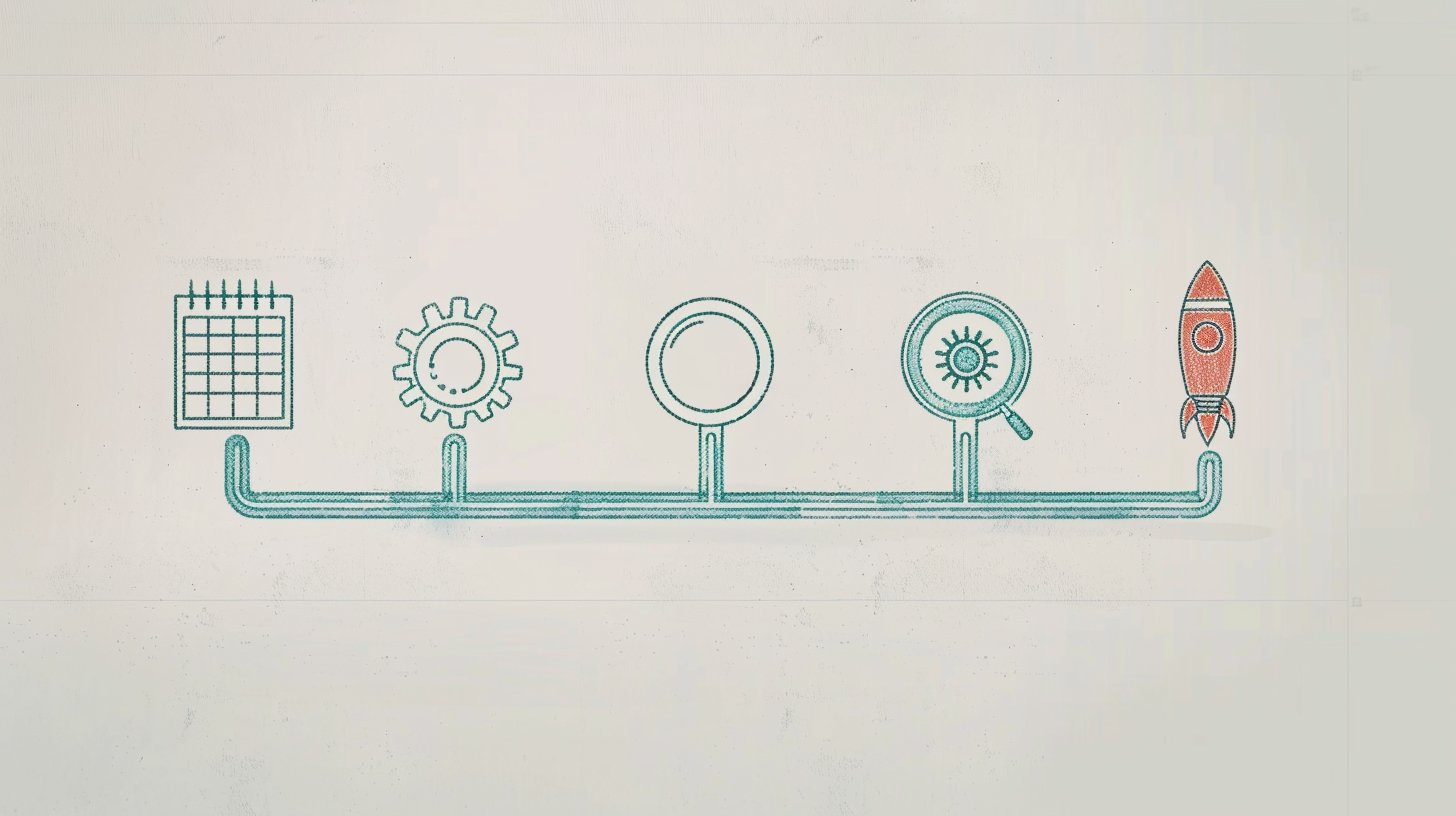
Four weeks sounds short. And that is exactly the point. This is not about spending a semester studying theory. It is about creating measurable changes in your workflows within a manageable timeframe. Here is how it works:
Week 1: Assessment
The first week is about listening and understanding. I look at how you and your team currently work. Which tools are in use? Where do you spend the most time on routine tasks? Which processes repeat themselves constantly?
In practice, that means we walk through a typical workday together. A typical example: in a trades company with eight employees, the office manager spends 45 minutes every morning consolidating inquiries from three different channels and forwarding them to the right colleagues. In an engineering firm, writing proposals regularly eats up half a day because the same text blocks are manually assembled every time.
By the end of the first week, we have a clear list: here are the biggest time sinks. Here is where the potential is highest. And this is where we start.
Week 2: The First Workflows
Now it gets practical. We set up the first AI workflows, working directly on the tasks we identified in Week 1. No practice scenarios, no fictional examples. Real work.
For a trades company like the one above, the solution might look like this: a workflow that automatically categorizes incoming inquiries and generates a summary with a recommended action. The office manager then reviews and distributes in ten minutes what previously took 45 minutes.
For the engineering firm: a prompt system that generates a proposal draft from project notes and a template. Not perfect on the first try, but a draft that is 80 percent there and only needs minor adjustments.
During this week, you also learn the fundamentals of good prompts. Not as a theory lesson, but through hands-on results: why does this wording produce a better output than that one? What happens when you give the model more context? How do you structure a request so that the response is actually useful?
Week 3: Going Deeper and Building Independence
In the third week, we go deeper. The basics are in place, and now comes the next level:
- (Semi-)automating workflows: What we set up manually in Week 2 is now configured to run with as little effort as possible in daily operations.
- Advanced techniques: Multi-step prompts that handle more complex tasks. For example: summarizing customer feedback from the last quarter, identifying patterns, and drafting an improvement proposal.
- Clarifying data privacy: Which data can go into which tool? Where are the boundaries? This is an important question, especially for SMBs handling customer data, and I take the time to answer it honestly.
The goal for this week: your team becomes more self-sufficient. The first team members start developing their own ideas for AI use cases. That is the moment when things get really exciting, because the people who do the work every day know best where AI truly helps.
Week 4: Wrapping Up and Making It Stick
The final week is the most important one. Not because the most happens here, but because we make sure that everything we have built actually stays.
We look back together: what worked? What did not? Where was the effort worthwhile, and where were the results disappointing? This honest review matters, because not every workflow we tried will be a winner. And that is perfectly fine.
Then we document everything that stays. Every workflow that proved its value gets written up so that colleagues who were not part of the coaching can use it too. No complicated manuals, just simple step-by-step descriptions: here is the prompt, here is how you feed it, here is how you check the result.
At the end, there is no certificate on the wall. Instead, there is something more valuable: a team that has not just tried AI but actually uses it in daily operations. Documented, understandable, and sustainable.
What This Delivers in Practice
I am reluctant to promise numbers because every business is different. But a realistic benchmark: teams can typically save between three and eight hours per week on routine work after four weeks. Not through some magic tool, but through targeted workflows that address the right pain points.
Just as important as the time savings is something else: confidence in working with AI. Before the coaching, there is often a mix of curiosity and unease. Afterward, the team knows what AI can do, what it cannot do, and where the limits are. That understanding is the real investment, because its impact extends far beyond those four weeks.
The First Step
If you have read this far, you now know how the process works. No surprises, no hidden upsells. Four weeks in which we figure out together how AI can concretely help in your daily work.
The first step is a free introductory call. 15 minutes where we talk about your current situation, answer your questions, and jointly assess whether the coaching makes sense for you. No sales pitch, just an honest conversation. Because I, too, want to make sure it is the right fit.
Related to This Topic
Get the free AI Starter Guide: 10 concrete ways to start using AI productively tomorrow.
Did this article spark an idea? Describe what you have in mind.