 software-architecture.ai
From Prompts to Agents: How AI Is Evolving From Text Generator to Real Tool
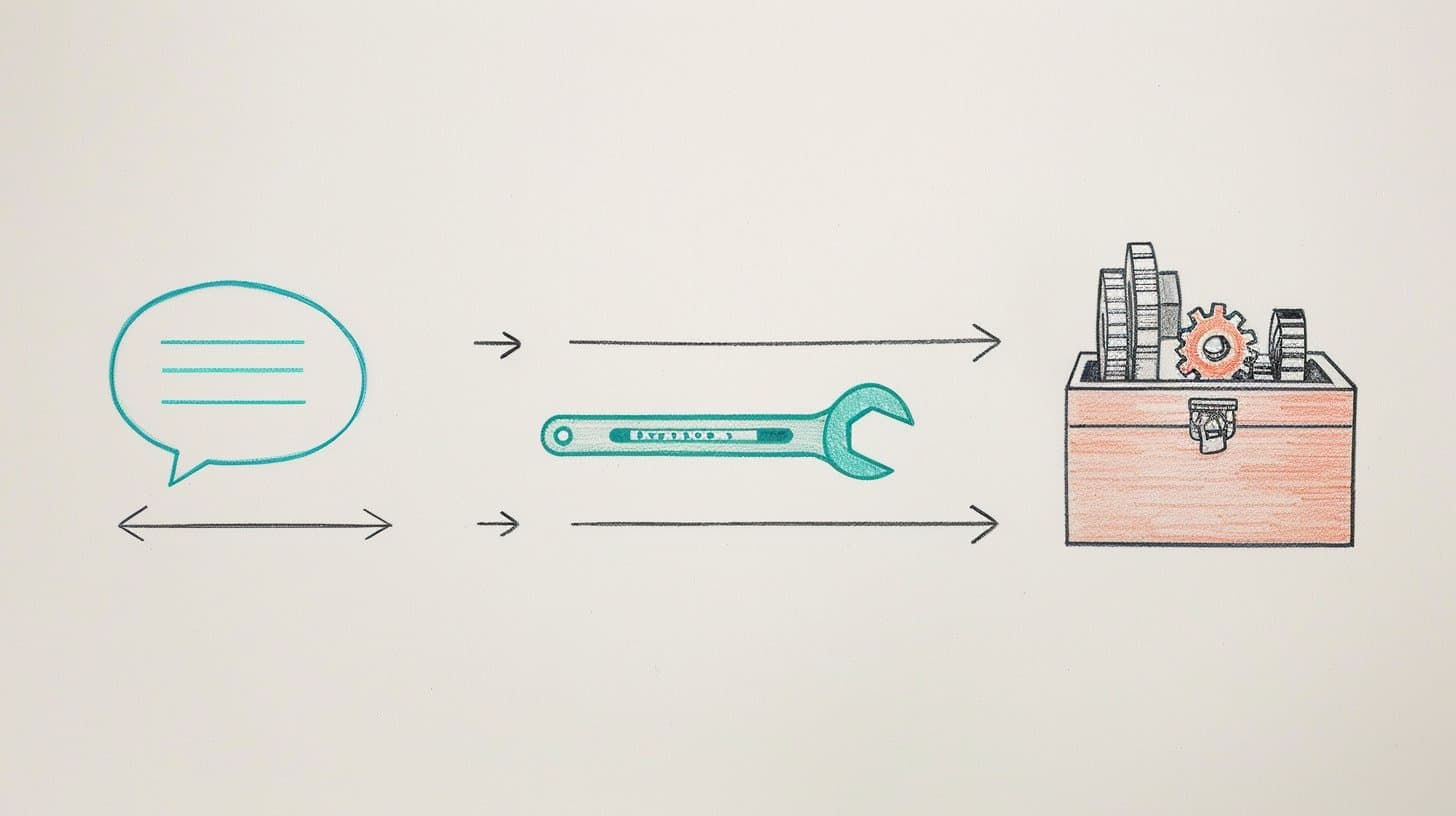
Two years ago, most companies tried AI for the first time: open ChatGPT, ask a question, get a useful answer. Draft texts, rewrite emails, brainstorm ideas, and suddenly everyone had a digital assistant. For small teams especially, it was a breakthrough: tasks that would have required hiring someone out could be done in minutes.
But that phase is already over. What is emerging now goes far beyond clever text generation and it affects small and mid-sized businesses more than many realize.
From Text Generator to Tool
The evolution has followed clearly recognizable stages. In the beginning, it was about single prompts: one instruction, one result. Good for texts, translations, simple research. Then teams started chaining multiple AI calls, using one result as input for the next step. Suddenly, AI could handle more complex tasks: analyze a customer report, derive recommendations for action, and draft a response.
The real leap is happening now: AI agents are gaining access to real tools. They read and write files, call APIs, interact with databases, search the internet. Instead of just generating text, they can execute actions. An agent can export a table from the CRM, process the data, and save a report as a PDF, all without a human steering every intermediate step.
What This Means for Small Businesses
For a 50-person company, this is a different category of tool entirely. Tasks that used to take someone half a day, such as gathering data, creating reports, and reconciling systems, can be completed with AI agents in minutes. This is not a theoretical advantage; it changes how small teams with limited resources can compete against larger rivals.
But with these new capabilities come new requirements. When an AI does not just generate text but takes action in real systems, you need to think about it differently:
Clear interfaces instead of improvised workarounds. Agents need cleanly defined access to the systems they are meant to work with. The clearer the interfaces, the more reliable the results. This applies to the CRM just as much as to the email service or the file system.
Traceability becomes essential. When an AI agent makes autonomous decisions, including which data it retrieves and which actions it executes, you need to be able to understand what happened. Not just when something goes wrong, but also for quality assurance and building trust within the team.
Errors happen differently. A typo in an email is annoying. An AI agent writing incorrect data into a customer database is a real problem. Systems must be built so that errors remain contained and can be easily corrected.
Permissions must be set consciously. An agent with access to everything is a risk. Just as you would not hand a new employee all the keys on their first day, AI agents should only receive the access they need for their specific task.
The Opportunity for Mid-Sized Businesses
What is emerging here is a genuine competitive advantage for small and mid-sized businesses. Large corporations have IT departments that build internal tools and automate processes. Smaller companies have had to handle these tasks manually or purchase expensive software that often was not quite the right fit.
AI agents change this dynamic. A well-configured agent can take over tasks that previously required custom software or additional staff. Not as a replacement for the team, but rather as reinforcement that takes over repetitive, time-consuming work and gives the team more room for the tasks that truly require human judgment.
- Customer communication: Agents that analyze email inquiries, categorize them, and prepare draft responses
- Reporting: Automated reports that consolidate data from multiple systems
- Documentation: Structured preparation of knowledge that otherwise exists only in the heads of individual team members
- Quality assurance: Automatic validation of data, processes, or results against defined standards
Use Deliberately, Don't Trust Blindly
The excitement is justified, but it must not obscure the risks. An AI agent with access to customer data, financial systems, or email accounts is a powerful tool. And powerful tools require conscious handling.
For small businesses investing in AI agents now, it is worth asking three questions: What exactly does the agent have access to? What happens when it makes a mistake? And can you trace what it did? If you can answer these questions, you are using AI agents not just productively but also responsibly.
Natural language is becoming a real interface for business processes. Not a replacement for expertise, but a powerful layer on top of it. Shape that layer deliberately, and you gradually build an agentic organization where agents work together instead of tinkering in isolation. The businesses that succeed in this new landscape will not be the ones that automate the most, but the ones that most consciously decide what to automate, and what not to.
Related to This Topic
Get the free Getting Started Guide: 10 concrete ways to start using AI productively tomorrow.
Did this article spark an idea? Let's find out which Sinnvampire can disappear for you.