 software-architecture.ai
When the human becomes the bottleneck: How semantic knowledge networks pull you out of the information flood
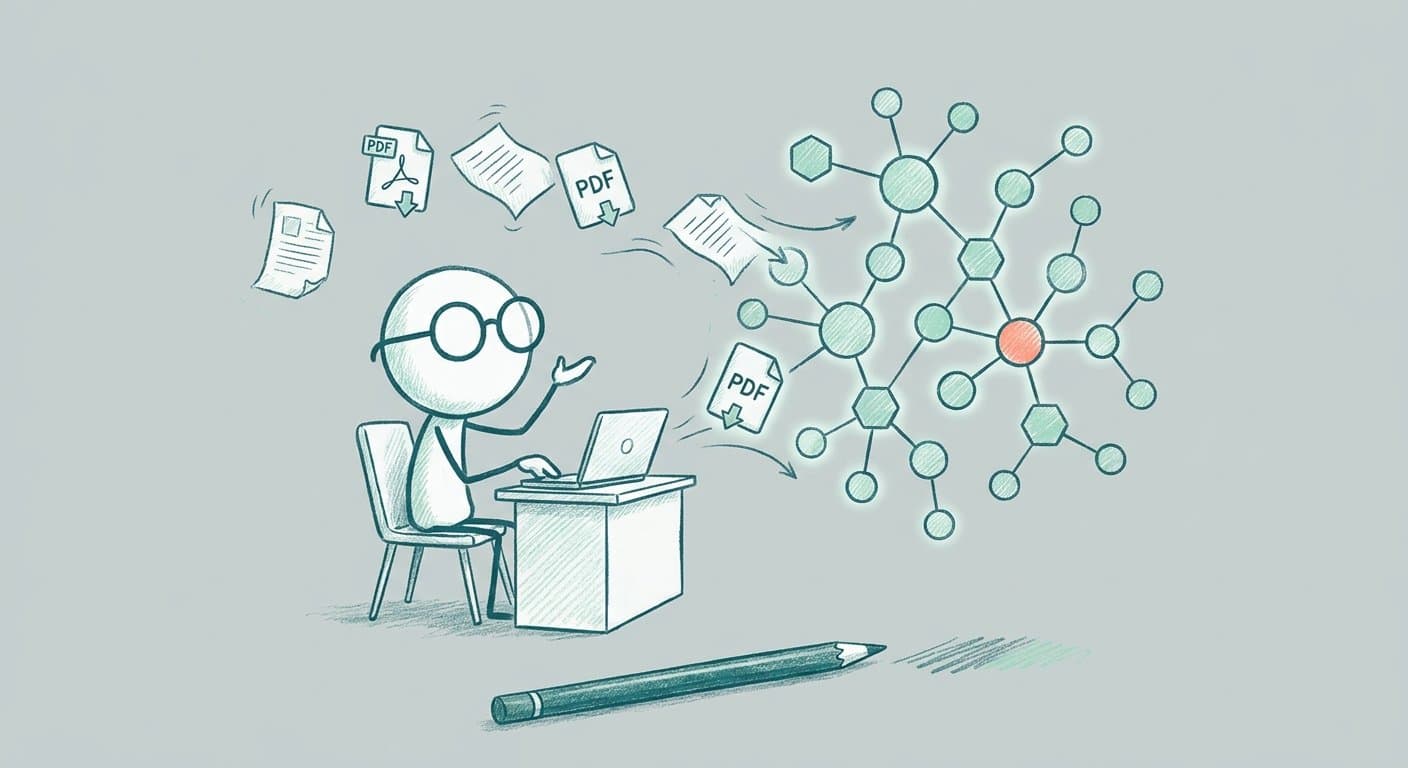
You know that moment when you open your laptop in the morning and a couple of agents are already coming back with suggestions? One has prepared a draft report. Another is asking whether it can send out an email.
You start reading. You have to decide. You have to evaluate. And while you are still on the first one, the next ones are already lining up.
A typical pattern: teams have finally got their agents running, the tools are delivering, and suddenly they realise: the machinery produces more output than a human can sensibly review. Not in an hour. Not in a day. This is where it starts to grind. And you usually feel that long before any dashboard shows it.
The good news first: there is a way out. Not through more discipline, not through yet another productivity tool, but through a different way of organising your knowledge. The keyword is semantic knowledge networks, and that is exactly where we are heading. But let’s first look closely at what this bottleneck is actually made of. Because it is often misunderstood.
What does it mean when the human becomes the bottleneck?
We often confuse this with “too much work”. But that is not what it is. Three constraints come together at the same time: too many decisions, too much information to sift through, too little context to safely sign off.
First, the decision load. Every agent output needs an evaluation. Is it correct? Do I send it out? Do I edit it? Do I let it run again?
Second, the volume of information. Every output comes with context, sources, intermediate steps. You don’t just have to evaluate the result. You also have to understand how it came about.
Third, the context gaps. The agent doesn’t know about the latest email from the client. It doesn’t know that the contract with supplier Müller has a special clause. It doesn’t know that the bookkeeper is on holiday. You have to feed in this knowledge every single time.
I wrote about the experience of suddenly having to decide all day in “Decision fatigue in the AI era”. What I describe there is one side of the bottleneck. The other side is the sheer volume of information trying to flow through you. And that volume is exactly where it gets interesting. That is where the lever sits.
How much time do knowledge workers really spend searching for information?
McKinsey measured it: on average 1.8 hours per day. That is roughly 9 hours per week, just to search for and pull together information (Source: McKinsey, The Social Economy).
9 hours a week, in a team of 10 people, makes 90 hours per week. 360 hours per month. A full-time role in your team is busy hunting down information that already exists somewhere. Nobody has a job description for it. It just happens.
And here comes the twist with agents. When you bring agents in, they get faster. They produce faster. But they often search the same fragmented knowledge space you do. With the same blind spots. They amplify the problem instead of solving it.
The DORA Report 2025 makes this pretty visible: code review times in teams using AI coding tools have gone up by 91 percent. Not (necessarily) because the code got worse. Because there is more of it and the review process didn’t scale (Source: Faros AI / DORA Report, 2025).
Translated: more output, more information, more to review. And as a human you sit in the middle and are supposed to evaluate all of it. That is where everyone hits the wall.
Why does the pressure grow as you add more agents?
Because every agent produces additional output that a human has to review, approve, or correct. The number of decisions grows linearly with the number of agents, but the cognitive capacity of the human does not. I described the structural mechanics behind this in “Human Attention is All You Need”: Amdahl's law, applied to human judgment.
The phenomenon itself is old. In human-machine research it is called “vigilance decrement”, described by Parasuraman and Manzey back in 2010: attention measurably decreases over time, especially on tasks where errors are rare. That is precisely the human role in an agentic organisation, spotting rare hallucinations and context errors in a flood of correct outputs. A recent review in the IJRIAS pulls these findings together in the context of human-in-the-loop frameworks (Source: IJRIAS, 2026).
BCG’s 2025 guide on Human-in-the-Loop spells it out: designers of HITL systems have to account for automation bias, fatigue and cognitive overload. Standard reviews are not enough (Source: BCG, 2025).
In day-to-day work it tends to sound like this: “I’m just rubber-stamping at this point.” “I click OK because I can’t read everything.” “If the agent says ‚looks good‘, I trust it. Otherwise I’ll never finish.” That is the truth. Nobody says it out loud. But that is what happens when the human becomes the bottleneck.
What is the solution when the human becomes the bottleneck?
Here comes the reframe. The human is not the problem. The knowledge is. More precisely: the way it sits. The human doesn’t need to be faster. The knowledge needs to be organised so that agents need fewer follow-up questions and the human needs to feed in less context.
As long as we believe the human just needs to be more disciplined, more focused, more productive, we’re not solving the problem. We’re only postponing it. From burnout today to burnout in six months.
The lever is not the human. The lever is the knowledge.
Concretely: most agents today work with unstructured knowledge. PDFs, Confluence pages, email threads. They search by semantic similarity. That is vector RAG. Works fine for simple questions.
But the real bottleneck questions are never simple. They are multi-step questions: “Which customers do we have whose contract expires in the next three months and who ordered less than usual over the past six months?” Three joins, a time filter. No vector search will find that. And this is where knowledge graphs come in.
How do semantic knowledge networks and knowledge graphs actually work?

A knowledge graph turns your company knowledge into a network of entities and relationships. Instead of “there is a PDF somewhere that sounds similar to your question” you have: customer Müller GmbH signed contract X, owned by person Y, and the contract contains clause Z.
Think of the difference like this. Classic search is a library where you find the right book. A knowledge graph is a librarian who has read the books and tells you: what you’re asking about is on page 47 of book A, explained more clearly in book B, and person C interpreted it differently in a talk.
If you are not yet familiar with retrieval-augmented generation, my “RAG explained” piece is a good entry point. Knowledge graphs are the next layer on top.
Cognilium ran a benchmark across query types, and the pattern is consistent. On simple lookups, vector RAG and GraphRAG sit close together, 91 versus 94 percent. On multi-hop queries the gap opens up: 54 versus 89 percent. On explicit relationship queries 41 versus 87 percent. Across all query types on average 57 versus 86 percent (Source: Cognilium, 2025).
Accuracy by query type
Where knowledge graphs make the difference
Source: Cognilium Benchmark, 2025
Diffbot’s own benchmark showed GraphRAG outperforming vector RAG by an average of 3.4x (Source: Diffbot KG-LM Benchmark, 2025). This is not academic decoration. This is the difference between “the agent has no clue” and “the agent can actually take work off my plate”.
Important: a knowledge graph doesn’t mean restructuring everything. Atlan puts it honestly: most companies should start with vector RAG plus structured metadata, then add knowledge graph components where cross-entity traversal is genuinely needed (Source: Atlan, 2025).
How does a small business actually get started?
Small. With one domain where relationships between entities shape your day-to-day. Customers, contracts, projects, suppliers. Not the entire company knowledge at once.
First, identify the bottleneck questions. What are the five questions you or your team answer multiple times a week, where you have to look in several systems each time? That is where the value is.
Second, model that slice once by hand as a graph. Which entities are there? Which relationships? Which properties? This is a finger exercise, an understanding exercise, not an IT project. A spreadsheet is enough. It helps you see how your knowledge is actually connected and it becomes the template for the ontology. Nothing more.
Third, let the agent work against the graph, not against the raw documents. That is the actual trick. The ontology becomes the lens through which the agent sees the world (Source: Aviso, 2025).
One thing worth knowing: nobody builds the actual company knowledge graph by hand. Once you understand what your entities and relationships look like, AI-powered tools take over the extraction from documents, CRM, tickets, emails. You curate the ontology, the tooling fills it. The spreadsheet exercise is therefore not the first step of a huge modelling project. It is the spec the machine extracts against later.
What you get out of it: when the agent works against a well-modelled knowledge network, it comes back with fewer follow-up questions. You feed in less context. You correct less. The bottleneck shrinks. Not because you got faster, but because the system got better.
What I bring from my work is a conviction. For a company with 5 or 15 people this is actually easier than for a corporation. You don’t have five data silos that haven’t spoken to each other in twenty years. You usually have three systems. Connecting three systems is doable.
The starting point fits on one page
The human becomes the bottleneck when the machinery scales faster than their context understanding. You don’t solve that by making the human faster. You solve it by organising the knowledge so that less context has to be fed in.
Knowledge graphs are not hype. They are the honest answer to the fact that your agents are good and your head is finite.
Three questions to start with. Which entities shape your day-to-day business? Which relationships between them do I need to keep in my head every day? Which question pops up every week and costs me half an hour of searching every time? Write them down. That is the starting point.
That is all you need at the beginning. No tool selection, no architecture debate. Just a deliberate decision about which knowledge is worth structuring. The rest comes later. And the rest is much smaller than most people think.
Over the next two years, the difference will become visible: which companies actually get their agents productive, and which ones produce burnout stories. The difference is not the model they use. The difference is whether they have done the homework of making their knowledge network-ready.
Related to This Topic
Get the free Getting Started Guide: 10 concrete ways to start using AI productively tomorrow.
Did this article spark an idea? Let's find out which Sinnvampire can disappear for you.