 software-architecture.ai
Sinnvampire: Tasks That Don’t Just Cost Time, But Drain the Meaning From Your Work
Picture this: You’re sitting on the couch after work. Long day. You powered through, no breaks, lunch at the desk. And then you ask yourself: What did I actually accomplish today?
You know you were busy. But you can’t point to anything. No customer problem solved. No meaningful conversation. No decision that moved the needle. You filled out spreadsheets. Answered emails that generated more emails. Copied data from one system to another. Pushed approval chains forward. Wrote status updates that nobody reads.
That’s not a bad day. For many people, that’s the default.
And the feeling isn’t wrong. Deloitte published a number in their Global Human Capital Trends Report that stuck with me: 41 percent. 41 percent of daily work time goes into tasks that create no measurable value for the organization (Source: Deloitte, 2025). Not 10 percent. Not 20. Nearly half the day.
Why one word changes everything
For a small business with five or ten people, that means nearly half your payroll funds work that doesn’t move anything forward. Not the difficult customer conversations or the complex projects. Those are exhausting, sure, but they have meaning. No, it’s the tasks nobody would miss if they disappeared tomorrow.
And there’s never been a good word for those tasks. “Inefficiency” sounds like management consulting. “Bullshit Jobs” is a book title, not everyday language. And “routine tasks” is too neutral, because routine can be a good thing: a Monday morning customer call, a team standup that gives everyone direction.
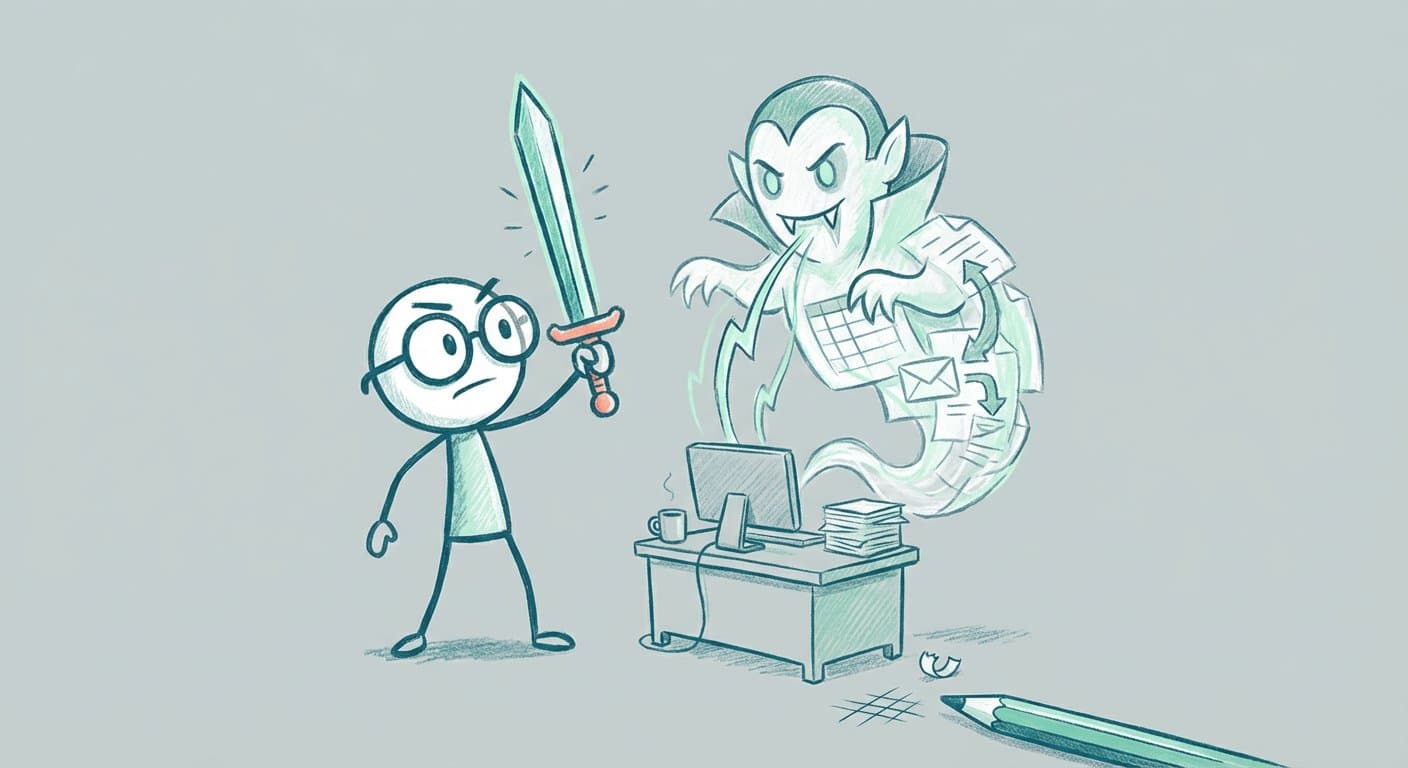
What was missing was a word for tasks that don’t just steal your time, but drain the meaning from your work. I call them: Sinnvampire. Literally: meaning vampires. Tasks that suck the purpose right out of your day.
What exactly is a Sinnvampir?
A Sinnvampir is a task that doesn’t leave you physically tired. It leaves you hollow. Three hours of copying spreadsheet cells. Getting stuck in approval chains. Transferring data between systems that don’t talk to each other.
Would anyone miss this task if it disappeared tomorrow? If not: Sinnvampir.
The litmus test is simple: Would a human being miss this task if it disappeared tomorrow? If not: Sinnvampir. If yes: not one.
A tough customer conversation? Not a Sinnvampir. It has meaning, even when it’s draining. A manual data transfer? Sinnvampir. Nobody misses it when it’s gone.
What happens when work has no purpose?
Gallup and Stand Together published their “Power of Purpose” report in August 2025. The findings are stark: employees who experience a strong sense of purpose at work are engaged at a rate of 50 percent. Employees with low purpose: 9 percent (Source: Gallup, 2025).
That’s not a small gap. That’s a completely different reality. And there’s more: only 13 percent of purpose-driven employees report regular burnout. For those with low purpose: 38 percent.
So when nearly half your day consists of tasks that generate no sense of meaning, it’s no surprise that engagement is in freefall. Globally, only 21 percent of employees are truly engaged, according to Gallup (Source: Gallup State of the Global Workplace, 2025). The problem isn’t that people lack motivation. The problem is that Sinnvampire steal the time they’d need to feel motivated.
Why AI alone won’t dissolve your Sinnvampire
Most people talk about AI as “the solution.” I see it differently. AI isn’t the solution. AI is the tool. But a tool needs direction. Without clarity about what you want to free yourself from, you’re just automating in circles.
When AI is “the solution,” you get what’s happening everywhere right now: companies buy AI tools, roll them out, and hope everything gets better.
Fortune reported in March 2026 on what actually happens: ActivTrak analyzed 10,584 users, 180 days before and after AI adoption. Time spent on email doubled: plus 104 percent. Messaging: plus 145 percent. Focused, uninterrupted work sessions: minus 9 percent. And the quote that hit hardest: “The data is unambiguous: AI does not reduce workloads.” (Source: Fortune / ActivTrak, 2026)
AI on its own doesn’t reduce workload. It often creates more. More output, more notifications, more digital busywork. That’s what happens when you deploy AI without direction. When you say: “Here’s a tool, go figure it out.” Instead of: “These are our Sinnvampire. They need to go.”
The difference: with AI as “a solution,” you automate anything and everything, including things that weren’t the problem. But when you know which tasks are your Sinnvampire, you can direct AI precisely where it makes the biggest difference. I explored why that matters in “Why AI Fails Without Humans”: only human judgment makes AI truly effective.
What I’ve come to believe through my work: AI doesn’t just need tasks. AI needs the right tasks. And “the right ones” means the ones whose disappearance makes the biggest difference. Not in hours. In meaning.
How do you find your Sinnvampire?
Three questions I always ask in my initial consultations. You can walk through them on your own.

Question 1: Which tasks would nobody miss?
Walk through your typical workday, hour by hour. Write down every task. Then ask yourself for each one: If this task disappeared tomorrow, would a human being miss it? Not a machine, not a process. A person. Would anyone say: “I miss that”?
Typical Sinnvampire I see again and again:
- Copying data from one system to another
- Manually reconciling invoices
- Writing status updates nobody reads
- Searching for information that already exists somewhere
- Scheduling meetings through endless email chains
- Approval loops where three people sign off on the same thing
Question 2: What do you keep doing, knowing there’s a better way?
There are tasks where every single time you think: “There must be a better way to do this.” That feeling is usually right. Not every such task is a Sinnvampir, but many are.
WorkTime analyzed aggregated productivity data and arrived at a remarkable number: employees lose an estimated 50 days per year to repetitive tasks that could be automated (Source: WorkTime, 2026). 50 days. That’s nearly ten work weeks.
Question 3: What leaves you not tired, but empty?
This is the emotional question, and it’s the most important one. Tiredness after a full day of real conversations, decisions, and creative work is healthy tiredness. The emptiness after a day of Sinnvampire is something completely different.
In the UK, 23 percent of employees say they’re bored at work. Only 29 percent feel fulfilled. Experts call it “boreout”: a long-term state of demotivation caused by work that feels meaningless (Source: YouGov / Mental Health UK, 2025). Boreout is the opposite of burnout, but it feels eerily similar. And Sinnvampire are the main driver.
What happens once you know your Sinnvampire?
Once you’ve identified your Sinnvampire, something shifts. You suddenly have a list. Not a vague “we should automate something” idea, but concrete tasks with names, with time costs, with a clear goal: let them go.
And then AI suddenly becomes more than “a tool we should try sometime.” It becomes a targeted instrument: Sinnvampir identified, solution built, Sinnvampir dissolved, time reclaimed. For a practical look at how this works, see the article on AI time savings for small teams: three workflows that return 15 hours per week.
The first step
Most people intuitively know where their Sinnvampire are hiding. What’s missing is a systematic inventory. And the clarity of which one to tackle first.
Three things have become important to me in this work:
First: not everything is a Sinnvampir. If you start labeling every task as one, the concept loses its edge. A Sinnvampir is specific: a task that drains both time AND meaning. A difficult customer conversation is not one.
Second: start with the biggest one. Not the easiest. The biggest. The Sinnvampir that drains the most energy should fall first. Because once it’s gone, you’ll feel the difference immediately. And that feeling carries you forward.
Third: you don’t have to do it alone. That’s exactly what the Freiraum-Plan is for: 60 minutes where I identify your biggest Sinnvampire with you and build a concrete plan for getting rid of them. No sales pitch, no PowerPoint. Just clarity.
People should be free to be people. Not data copiers. Not approval chains. Not status-update machines. And Sinnvampire are what stands in the way.
You know their name now. That’s the first step.
Related to This Topic
Get the free AI Starter Guide: 10 concrete ways to start using AI productively tomorrow.
Did this article spark an idea? Let's find out which Sinnvampire can disappear for you.