 software-architecture.ai
From agentic coding to agentic organisation
Developers get more productive, organisational delivery stays flat. The problem isn't the technology. It's the pipes around it that don't scale with it.
Read articleThe chatbot in the bottom right accesses my Brand-Voice Engine. Ask it something: what comes back carries a source from two years of content, or nothing at all.
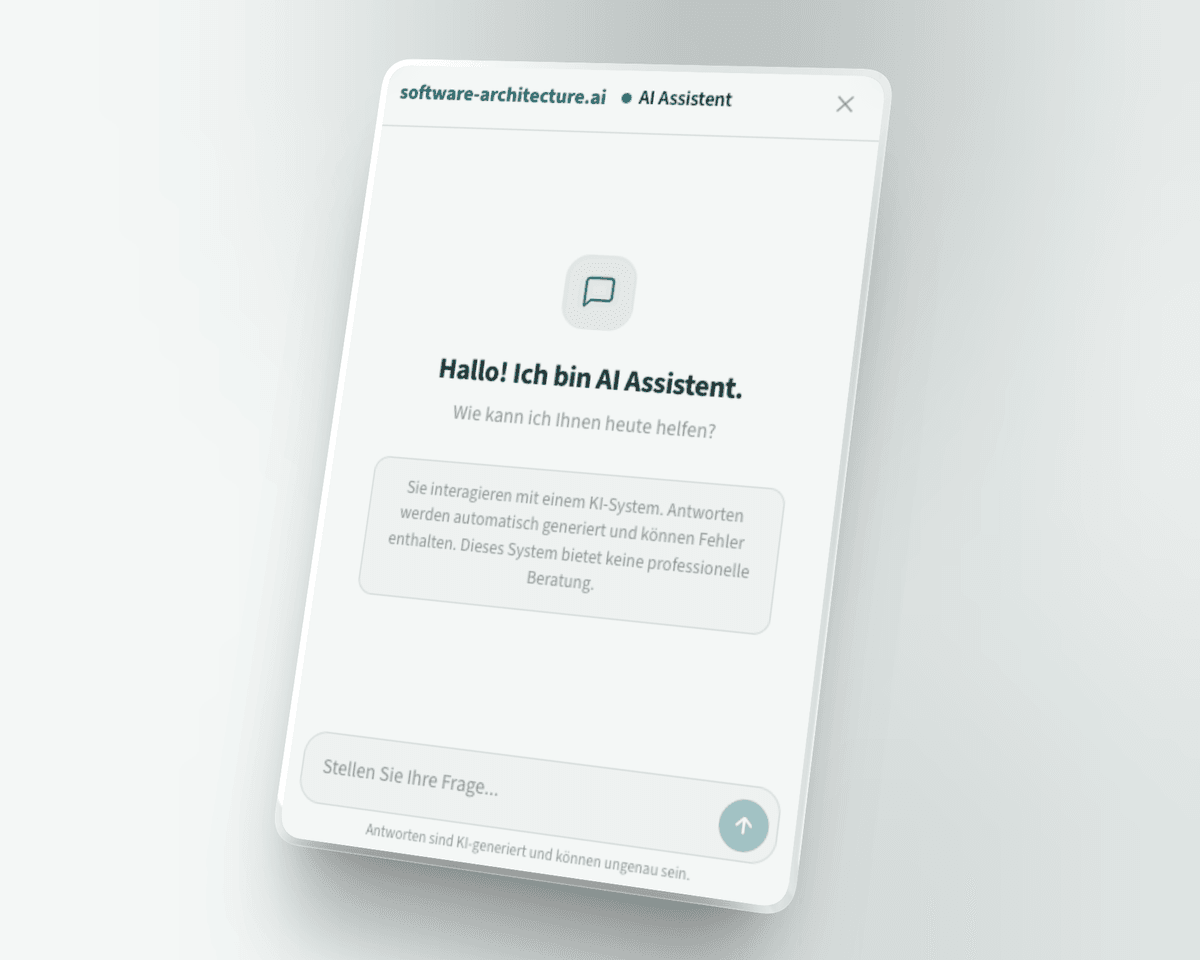
Brand-Voice-Engine: the system of brand codex, voice adapter, and escalation logic that turns your brand into brand-aligned answers. The chatbot in the bottom right is not the engine, it's an interface that operates by using the engine.
Ask the chatbot in the bottom right a question before you read on. Ask it, for example, what brand voice under scaling pressure means. Read the answer. Then decide whether this page is relevant for you. You're not really reading the chatbot. You're reading the engine through it.
Engine is not chatbot
What you write to in the bottom right is a surface. The Brand-Voice Engine sits behind it, as a structured layer between brand codex and language model. The same engine feeds other touchpoints where my brand has to sound like me, even when I'm not the one typing.
Three articles produced using this engine:
Developers get more productive, organisational delivery stays flat. The problem isn't the technology. It's the pipes around it that don't scale with it.
Read articleWith every new AI feature, work shifts from typing to deciding. How to stay clear as the mini-CEO of your agents, before the fatigue finds you.
Read articleAgents produce more output than a human can sensibly review. Where the bottleneck actually sits, and how semantic knowledge networks make it smaller.
Read articleThe engine is more than a language model on a database. It is the system of three components that all have to interlock so the chatbot in the bottom right speaks in my tone, not the model's. The chatbot itself is only the surface, the translator between you and the system underneath.
First component: the brand codex. In my case that's over thirty blog articles, all service pages, the about page. They aren't just data. They are the form from which the engine understands what my brand is and what it explicitly is not.
Second component: the voice adapter. A question about AI coaching sounds different than one about software architecture. Both stay in my tone, because the adapter sits between codex and answer and holds the corridor my brand is allowed to move within.
Third component: the escalation logic. When the engine can't answer a question from my content, it makes the chatbot say so honestly and sends you to the contact page. There's no improvisation.
The engine runs entirely on European infrastructure. Mistral as the foundation layer, a Paris-based company with European ownership. My own database on servers in Europe. No detour through US data centres, no GDPR disclaimer as a consolation prize.
But sovereign AI was the precondition for me, not the argument. The US ecosystem builds excellent tools, and a lot of what I work with day to day comes from there. For a brand-aligned engine that operates from Europe and carries customer data, the calculation flips: routing that data outside Europe would cannibalise the engine's own logic. Data protection here isn't a marketing layer, it's the build I can stand behind for a Mission-Brand based in Europe.
For Mission-Brands operating from Europe, data sovereignty is worth treating as the baseline, not a bonus.
An engine matters as much for what it leaves out as for what it does. Two lines I drew deliberately.
When a question can't be answered from my documented content, the engine has the chatbot say so openly instead of inventing a plausible answer. The escalation goes to the contact page. Hallucinations are not a technical risk, they are a brand risk. A brand that makes things up loses its anchor faster than it builds one.
Personal inquiries, values discussions, crisis communication, individual project requests: there the chatbot deliberately stays silent, because the engine tells it to. Those answers belong to me, not to my site. The escalation line is part of the build, not a disclaimer.
Together this gives an engine that is strong in what a Brand-Voice Engine is supposed to do: make knowledge from documented content accessible in a brand-aligned way, through whichever interface plugs into it. And steps back from what belongs to the person behind the brand.
EU-First
Mistral, servers in Europe
30+
pieces of content as brand codex
Sources
in every answer, otherwise escalation
If you ask a question I haven't written about anywhere, the chatbot says so honestly, because the engine doesn't let it guess. It sends you to the contact page. That's not a bug, it's the most important safety default of the whole system. Better no suggestion than a fabricated one.
Three pillars, three application areas, three ways to translate what you saw here onto your brand.
When your brand grows quieter with every email because others are writing alongside you: the same engine inside your Klaviyo stack, with your brand codex and touchpoint adapters for welcome mails, service answers, and product copy.
To the Brand-Voice EngineWhen standard chatbots clear your service volume but take your brand with them: the same architectural pattern in your Gorgias or Zendesk stack, with clear triage logic between routine and brand moment.
To the Service-Routing EngineWhen your implicit knowledge lives only in your head and your team asks you every week: the same pattern as a Founder-Brain with documented values codex and Slack integration.
To the Founder-Brain
Describe your situation. I'll tell you honestly what can come of it.