 software-architecture.ai
New Google reviews pile up, and you never get around to writing a proper reply.
The reviews nobody has answered in weeks: an AI agent for Google reviews

Short answer
Reviews come in exactly when you have no time for a good answer. An AI agent spots new reviews, drafts a reply in your tone and hands it to you for approval. You read, adjust, approve. Only then does the reply go out. The agent handles the dull catching-up, the final call stays with you.
The scene you know
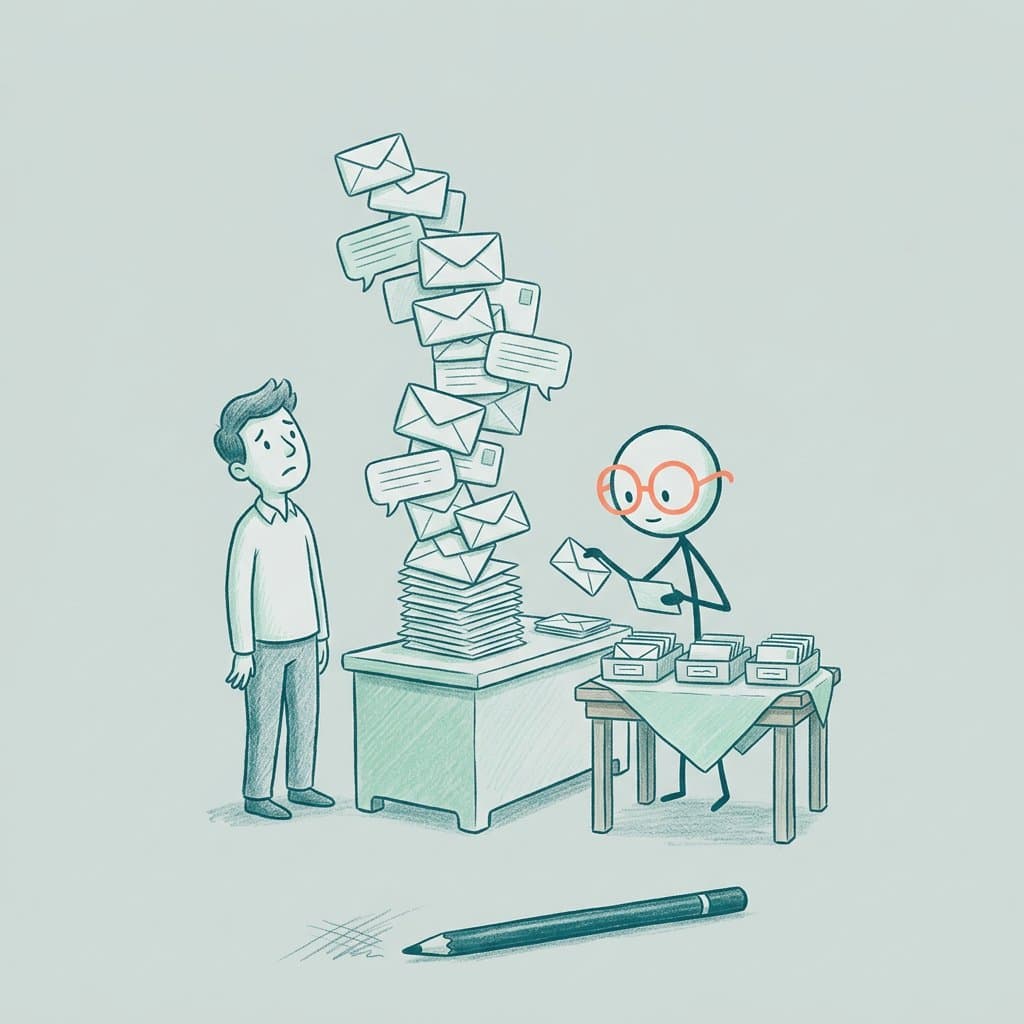
Deniz (fictitious name) runs a small restaurant, twelve tables, a good team. There is a red number over the Google Maps app on his phone: fourteen new reviews he has not answered yet. The oldest is three weeks old. It is not that he does not care. It is just never the right moment. When the place is full, he is cooking and serving. When it is empty, Deniz is doing the books and ordering supplies.
Between the four-star reviews sits a two-star one: „Food was good, but we waited 40 minutes for the starter.“ That is exactly the one that should get a friendly, composed reply, because it is the first thing the next guest reads when they search for a restaurant nearby. Deniz knows this. Still it slips down the list, because the next one is already coming in at the top.
The bitter part is not the one critical review. It is that the whole profile looks unattended. Fourteen people took the trouble to write something, and nobody responded. To someone who does not know the restaurant yet, that looks like a place where nobody listens. And that is exactly what is not true.
Why this is a brand problem, not a too-lazy-to-type problem
The temptation is to read this as „I just need to sit down and do it“. But it is not that. Replies to reviews are not a private note, they are public brand communication. Every reply stays under the review forever and shows how your business handles praise and criticism. That is reputation work, and reputation work that never gets its turn does not stop being important.
The writing itself is the highly repetitive part: read, grasp the core, phrase it warmly and in the right tone, thank or address. Exactly this kind of task is well suited to be handed to an agent. What cannot be delegated is the judgement: is this reply truly in your spirit, does it fit the case, should it go out like this. The agent takes the phrasing off your plate, you keep the last word.
There is also a detail that is delicate precisely with reviews: a reply that misses the mark is worse than none at all. A smooth, feelingless boilerplate phrase under an honestly disappointed review does more harm than good. That is why the approval step here is not a safety net you drop later, it is the actual architectural decision. The human stays in, because here the tone decides the effect.
Where the reputation really suffers
The damage does not happen loudly. It seeps away at three points, and none of them shows up in a statistic.
The critical review left unanswered
A bad review is not the problem, a bad review with no response is. Whoever reads a calm, solution-minded reply beneath it sees a business that takes responsibility. Whoever reads silence sees a business that does not care. The reply is never aimed at the person who already wrote, but at the ten who read along afterwards.
The praise that runs into nothing
Four- and five-star reviews often get no reply at all, because they are „good“ already. Yet a short, personal thank-you is the cheapest relationship signal there is. It costs two sentences and shows everyone reading along that someone is listening here. You give that signal away the moment the replies pile up.
The profile that looks abandoned
It is not the single missing reply, it is the sum. A profile where nobody has reacted in weeks looks unattended, no matter how good the stars are. Freshness and responsiveness are a trust signal, and it decays quietly, without anyone telling you that you are losing customers right now.
What people try that does not hold up
- The fully automatic reply bot. An AI that posts in your name unchecked is exactly the kind of risk you should not take with public brand communication. A single sentence that misses the mark under a sensitive review stays there forever.
- The copy-paste phrase. „Thank you for your feedback!“ pasted under every review, whether praise or complaint. It reads like a machine and undermines the very trust the reply is meant to build.
- Saving it all for later. Work through every review in one go once a month. In practice it does not happen, and even if it does, a reply after three weeks is worth half as much as one after two days.
- Yet another platform with its own login. An extra tool nobody logs into only shifts the load. The problem is not the missing tool, it is that the drafting lands on you at all, in moments when you cannot afford it.
How it is solved: the agent drafts, you approve
The solution is not another inbox, it is an agent that takes on the reading and writing part and leaves you only the decision. From your point of view the flow is deliberately calm: when a new review comes in, you get a short message with the review and a finished reply draft in your tone. You read it, nod it through, tweak half a sentence or send it back for a rework. Only after your approval does the reply go out.
Under the hood, more happens than it looks. The agent checks your Google Business Profile regularly for new reviews (clean, controllable polling on a schedule is more stable here than any hacky real-time trick), reads stars and text, recognizes the case (praise, factual criticism, complaint, a review with no text at all) and generates a draft with a language model that fits your voice and your rules. These steps are wired up as tools the agent calls deliberately: fetch new reviews, create a draft, present it for approval, post after approval.
The decisive point for you: before publishing, the agent pauses and waits. Nothing goes out without your thumb. You set the rules for when it reacts differently: a one-star review that names staff, a legally tricky claim, an offensive text. The agent does not draft those away blindly, it flags them and hands them to you with a more cautious suggestion instead of guessing.
Approval runs where you already are, by email, over Slack or Teams, or via a small internal board if you want an overview of open and handled reviews. You need no new tool to log into separately. The reply itself is posted through the Google interface after your approval, and the posting can still be briefly delayed by Google's own review. That is normal and we plan for it.
And Google is only one entrance, not a must. Because the agent sits in the middle, not the channel, the same logic can later extend to other review sources, such as industry portals or booking platforms. The reply logic behind it stays the same, only the source a review comes from changes. You start where it hurts most, and add the other sources when it pays off.
An honest word on the setup: the tricky part is not the writing, it is the Google side. The Business Profile has to be verified, the API access set up cleanly via a Google Cloud project, the rights and permissions configured correctly. It is well doable, but it causes more friction at the start than the agent logic itself. That is why we settle that first, before building the rest.
When you do NOT need this
- If you only get a handful of reviews a year. Then it is done by hand in five minutes and the build does not pay off.
- If someone on the team does this gladly and well and reviews get answered the same day anyway. Then you are not automating away something that already runs smoothly.
- If reviews honestly do not matter to you and play no part in winning customers. Then a review agent solves a problem you do not have.
- If your Google Business Profile is not even set up or verified yet. Then the first step is the profile itself, not the agent on top of it.
How we build this concretely
This is a tailored piece of the Customer Service Engine: a review agent that spots new Google reviews, drafts replies and hands them to you for approval. We start small and honest, with a pilot for the most common case, so you can feel how it works in real daily life before we build out special cases and further sources.
The intent behind it: the agent takes the dull phrasing off your plate, not your business's voice. It prepares, you decide. And you set yourself what it may propose on its own and which cases always pass over your desk.
This is a starting point, not a rigid package. Just reach out, then we look together: some things can be simplified, others expanded, all of it tailored to your business.
Google review agent
the agent drafts, you approveReview pilot
- Connection to your verified Google Business Profile (Google Cloud project, OAuth, permissions set up cleanly)
- Detection of new reviews on a controlled schedule (more stable than hacky real-time tricks)
- Reply draft via a language model in your tone, for praise, factual criticism and reviews with no text
- Approval step of your choice: by email, Slack, Teams or a small internal board
- Rules for special cases: one-star, staff mentions, offensive, legally tricky are flagged and presented more cautiously
We first set up the Google access cleanly and build the most common case end-to-end. Once the pilot runs, we extend it with multiple locations, escalation rules and further review sources.
Common questions
- Does the agent post replies automatically in my name?
- No, not in the first stage. The agent drafts, you approve, only then does it post. Especially with public brand communication this approval step is not a convenience, it is the right architectural decision. Later you can clear uncritical standard cases once you have settled into it.
- What happens with really negative or delicate reviews?
- The agent does not draft those away blindly. One-star reviews, offensive texts, legally sensitive claims or the naming of staff are flagged and handed to you with a more cautious suggestion. You decide, the agent only prepares.
- What platforms do I need in place to start?
- A verified Google Business Profile with admin access is the basic requirement, without it reviews can be neither read nor answered reliably. On top of that a Google Cloud project with the interface enabled for API access, a language model for the drafts, and an approval channel like email, Slack or Teams. Optionally a small board for the overview. We set up the Google part together.
- How fast is my reply online once I have approved?
- Usually quickly, but not always in the same second. Google reviews replies before publishing, which mostly takes only a few minutes, in some cases longer. If you expect „instant live“, that is good to know: the agent and your approval are fast, Google's own check sits after that.
- How long does the build take?
- The pilot for the most common case stands in a manageable timeframe. What needs some patience is the Google part: verification, API access and getting the permissions right cause more friction than the agent logic itself. That is exactly why we settle it first and plan it in from the outset.
All names of individuals and companies used in this use case are fictitious. Any resemblance to real persons or businesses is purely coincidental and unintentional. The examples are provided solely for illustrative purposes.