 software-architecture.ai
Bookings arrive by WhatsApp and phone exactly when you have scissors in your hand.
The salon that keeps booking at eleven at night: an AI agent for hair-salon appointments
Short answer
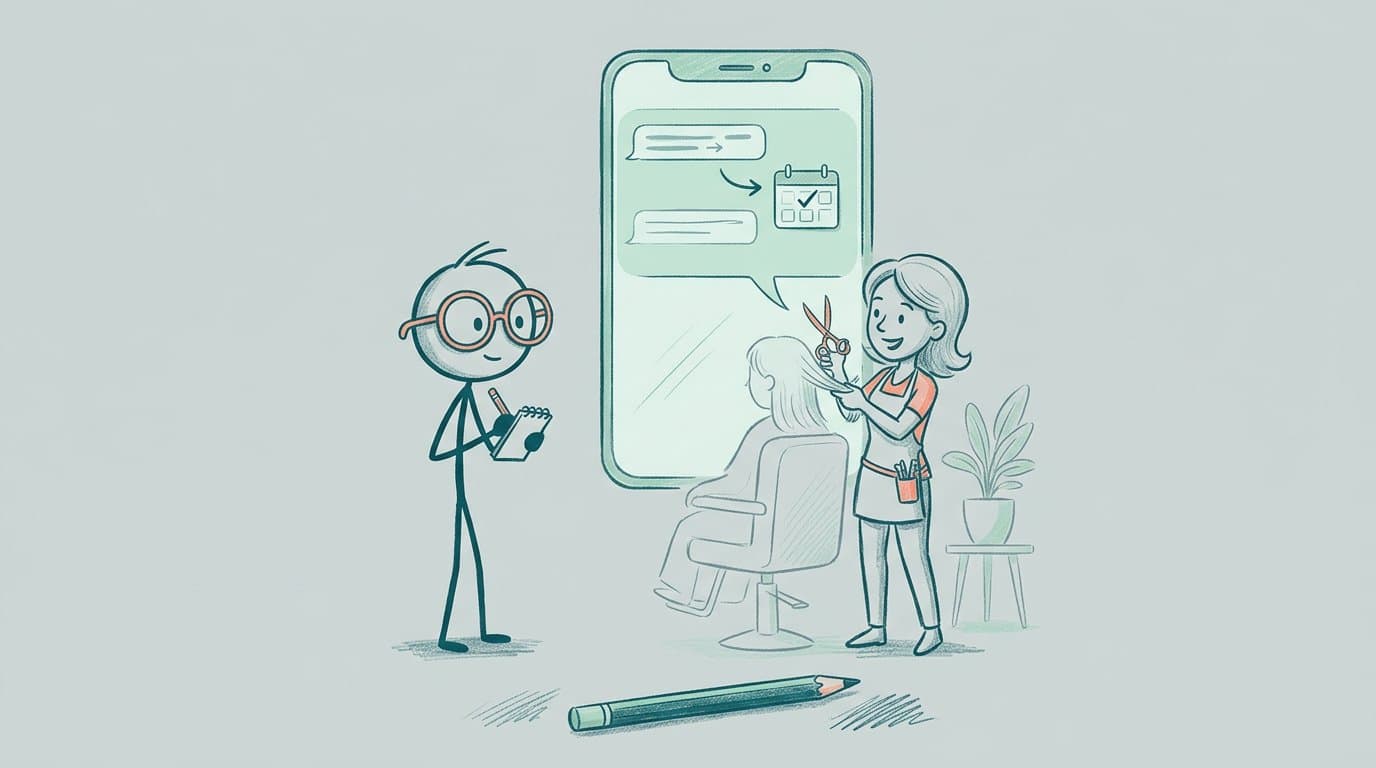
Requests come in when you can least answer them: mid-cut or after closing. An AI agent takes the request over WhatsApp, checks your calendar, offers open times and books the appointment while you are at the chair. You keep your hand on it, the agent handles the repetitive back-and-forth.
The scene you know
Mira (fictitious name) runs a small salon, two chairs, her and a colleague. It is Tuesday, half past two, and she is in the middle of a foil job. The phone rings. She cannot pick up, her hands are full. It rings again. On the second phone a WhatsApp lights up in parallel: „Hi, do you have anything free Saturday for a cut and blow-dry?“
Mira only sees the message just after eight, when the shop is closed and she should really be off. She types back, asks for a time, gets an answer at nine, suggests eleven, and by then the customer has booked elsewhere. Three messages, an hour and a half of waiting in between, no appointment.
The bitter part is not the one lost Saturday. It is that Mira spends her evening on the sofa still handling bookings, while during the day every request either interrupts the customer in the chair or sits unanswered. The scissors and the phone fight over the same ten seconds.
Why this is a time sink, not a staffing problem
The temptation is to read this as „I need someone for reception“. But a second person sitting at the counter for eight hours waiting on the phone does not pay for itself in a two-chair salon. And the real problem is not the missing hand, it is the nature of the task.
Booking is a highly repetitive, predictable flow: which service, how long does it take, who is free, does the slot fit. Exactly this kind of task is well suited to be handed to an agent. What cannot be delegated is what Mira actually does: cut, advise, listen. The agent takes the dull part off her plate so she is free for the real thing.
There is also a detail that makes WhatsApp the natural place for this: the moment a customer messages you, a 24-hour window opens in which you may reply freely. A booking dialogue fits neatly inside it, since it is done in a few minutes. You need no app that nobody installs and no link that rips the conversation out of WhatsApp. The customer stays in the chat they are already writing in.
Where the appointments really leak away
The loss does not happen loudly. It seeps away at three points, and none of them shows up in a statistic.
The message after closing
Most requests come in the evening and on weekends, exactly when nobody is at the counter. Every hour a reply takes is an hour the customer keeps searching. Whoever names a concrete time first wins the booking, and that is rarely the salon that writes back the next morning.
The ring mid-cut
If you do pick up, the customer in the chair pays the price. The consultation breaks off, the blow-dry is half done, attention is split. Booking and the service in progress compete for the same person, and in the end both suffer.
The no-show with no reminder
An appointment made by phone two weeks ago that nobody remembers is an empty chair. Without an automatic reminder the day before, some of the seats stay unused even though they count as booked.
What people try that does not hold up
- The rigid button bot. „Press 1 for an appointment, 2 for opening hours.“ The moment a customer phrases freely what they want, it falls over. It feels like a hold queue, not a salon.
- Your own booking app. Nobody downloads an app for a haircut appointment. The effort is higher than the call you were trying to avoid in the first place.
- The bare booking link in the bio. It works for those who find it, but it breaks the WhatsApp thread. The customer would have to leave the conversation, which is exactly where many of them drop off.
- Answering everything yourself, just faster. That does not scale and only shifts the load into your evening. The problem is not your typing speed, it is that the task lands on you at all.
How it is solved: the agent sits in the chat, you keep your hand on it
The solution is not another tool on top of the calendar, it is an agent that works directly inside the WhatsApp conversation. From the customer's point of view the flow is boringly calm, and that is the goal: they write „Saturday, cut and blow-dry?“, get two or three suitable times within seconds, pick one, and have the confirmation in the chat. No call, no app, no waiting until next morning.
Under the hood, more happens than it looks. The agent reads the request and understands that „cut and blow-dry“ needs about an hour, asks back if something is missing, checks your real calendar for which gaps fit, and only proposes times that are genuinely free. These steps are wired up as tools the agent calls deliberately: check availability, create appointment, schedule reminder. Technically this rests on a graph (LangGraph) that models exactly these states cleanly, instead of ending up in a tangled web of if-then rules.
The decisive point for you: the agent can pause before it actually writes anything in and wait for your confirmation. You decide whether it books standard appointments on its own and only brings you the exceptions, or whether every appointment passes over your desk once. The human stays the final authority, the agent only does the dull part in front of it.
Bookings go into the system you already use, such as a calendar like Google Calendar or a booking tool like Cal.com. The day before, the agent automatically sends a short reminder, which noticeably reduces the empty chairs from no-shows. And anything it cannot answer with confidence, an unusual colour request, a complaint, a delicate special case, it hands to you instead of guessing.
And WhatsApp is only one entrance, not a must. Because the agent sits in the middle, not the channel, you can just as well put a booking widget on your website, an Instagram direct-message inbox or even the phone line in front of it. The booking logic behind it stays the same, only the door the customer comes in through changes. You start where your customers already write, and add the other doors when it pays off.
An honest word on data protection: WhatsApp belongs to Meta, and the messages run over their infrastructure. This only becomes defensible with clear guardrails: a dedicated device with no address-book sync, your customers reaching out first, informed consent that names the Meta metadata too, an alternative booking channel, and a documented risk assessment. Some data-protection lawyers still see even that as shaky ground and point to Signal or Threema instead. That trade-off belongs in the design from the start, not patched on afterwards.
When you do NOT need this
- If your customers come almost entirely as walk-ins and rarely book ahead. Then a booking agent solves a problem you do not have.
- If your appointment volume is so small that the few requests per week do not throw you off. The build only pays off once booking visibly costs you time or appointments.
- If you have a receptionist who does this gladly and well and is busy enough that it pays for itself. Then you are not automating away something that already runs smoothly.
- If almost all your appointments are made in person at goodbye („see you in six weeks, same time?“). Then your bottleneck is somewhere else.
How we build this concretely
This is a tailored piece of custom software: a WhatsApp booking agent wired to your calendar. We start small and honest, with a pilot for the most common case, so you can feel how it works in real salon life before we build out the special cases.
The intent behind it: the agent takes the booking back-and-forth off your plate, not the relationship with the customer. It does the dull part, you do the thing they come for. And you decide yourself how much it may settle on its own and from when it asks you.
This is a starting point, not a rigid package. Just reach out, then we look together: some things can be simplified, others expanded, all of it tailored to your salon. That is exactly what you gain with custom software, it adapts to you, not you to it.
WhatsApp booking agent
the agent books, you keep your hand on itBooking pilot
- WhatsApp connection (Twilio to start, switch to the Cloud API on build-out)
- Booking agent for the most common case: understand the request, propose open times, create the appointment
- Connection to your calendar (Google Calendar or Cal.com)
- Automatic appointment reminder the day before to cut no-shows
- Confirmation level of your choice: standard automatic, exceptions to you
We take a typical booking case from your salon and build it end-to-end. Once the pilot runs, we extend it step by step with services, a second colleague and special cases.
Common questions
- Does the agent replace my receptionist?
- No. It takes off the recurring booking back-and-forth that nobody enjoys anyway, especially in the evening and mid-cut. What stays is the time for the customer in the chair. That is what the agent is for, not to rationalize people away.
- What if a customer wants something unusual?
- Then the agent does not book blindly, it hands the case to you. It is set up to ask rather than guess when in doubt. You decide, the agent only prepares.
- Is this clean on data protection?
- WhatsApp runs over Meta, that has to be acknowledged. It becomes defensible under clear conditions: a dedicated device with no address-book sync, your customers initiating contact first, informed consent that covers the Meta metadata, an alternative booking path, and a documented risk assessment. Some data-protection lawyers still consider even that shaky and recommend Signal or Threema instead. That's exactly why this gets discussed openly upfront, so you can decide what actually holds up for your salon.
- What does WhatsApp cost me per message?
- If the customer writes to you and books within 24 hours, that is usually free. Costs arise mainly for messages you send on your own initiative outside the window, such as a reminder the day before, and those are small and predictable.
- How long does the build take?
- The pilot for the most common booking case stands in a manageable timeframe. What needs some patience is the WhatsApp approval at Meta: verification and the sign-off of reminder templates can take a few days. We plan that in from the outset.
All names of individuals and companies used in this use case are fictitious. Any resemblance to real persons or businesses is purely coincidental and unintentional. The examples are provided solely for illustrative purposes.