 software-architecture.ai
Clear Head, Business Running: How to Actually Switch Off as a Founder
You close the laptop. Day’s over. But your brain keeps running: Did the client respond to that proposal? Is the shipment going out tomorrow? Did I send that invoice? That constant hum in the background that just won’t stop.
Your brain is not a hard drive. And that’s exactly the problem. Most freelancers and small business owners use their brain as a task manager, a reminder system, a scratchpad. But it wasn’t built for that. If you want to switch off as a founder, you don’t need discipline. You need systems your brain trusts.
Why is your brain still buzzing when the laptop is already closed?
I know the feeling. You’re on the couch, technically free, and suddenly you remember an email you didn’t answer. You get up, open the laptop again. Or you wake up at 2 AM thinking about a task. This is not a personal failure. It’s a structural problem.
The 2025 German SME Study by “In guter Gesellschaft” has a number that hit me hard: 44 percent of female entrepreneurs surveyed report feeling mentally exhausted frequently. For men, it’s 29 percent. 34 percent of female entrepreneurs are affected by burnout (Source: In guter Gesellschaft, 2025).
This doesn’t happen because you’re badly organized. It happens because as a founder, you carry everything in your head. Every open task, every unanswered message, every decision still pending.
There’s a psychological term for exactly this phenomenon. And once you understand it, you’ll see why “just switch off” doesn’t work.
What is the Zeigarnik Effect, and why does it hit founders hardest?
In the 1920s, Russian psychologist Bluma Zeigarnik observed something fascinating. In a restaurant, she noticed that waiters could remember open orders perfectly but forgot everything the moment the bill was paid. This became the Zeigarnik Effect: our brain treats every unfinished task as an open loop that it actively keeps in working memory. Like a browser tab running in the background, consuming energy (Source: Psychology Today).
The impact is measurable. According to the American Psychological Association, the mental strain from unfinished tasks can reduce productivity by up to 40 percent (Source: APA, 2025). 40 percent. That’s nearly half your cognitive capacity going to open loops.
On top of that: task switching. MIT research shows that entrepreneurs switch tasks every 11 minutes on average. And each switch costs up to 23 minutes to get back into deep focus (Source: MIT Attention Research, 2024). Meaning: you never actually reach flow during the day.
73 percent of entrepreneurs surveyed report that their best thinking happens in less than 10 percent of their working hours. The rest is noise (Source: Global Entrepreneur Cognitive Health Study, 2025).
And then there’s decision fatigue. The 2025 Stanford Decision Science Study showed that decision quality degrades by up to 40 percent over the course of the day. It happens quietly, you don’t notice it. But by the afternoon, you’re objectively making worse decisions than in the morning (Source: Stanford, 2025).
Click the × to close a tab
Up to 40% productivity loss from open loops (APA)
Now for the good news. The fix is surprisingly simple.
How do you clear your head when the to-do list never ends?
In 2011, psychologists Masicampo and Baumeister discovered something remarkable. In their study “Consider It Done,” they showed that simply writing down a concrete plan for an unfinished task is enough to stop the intrusive thoughts. Not the completion itself. Just the knowledge: there’s a plan I trust. Then the brain lets go (Source: Masicampo & Baumeister, 2011).
It’s not completing the task that resolves the mental load. It’s knowing there’s a plan you trust.

What I’ve learned from my work: the mistake isn’t that you have too much to do. The mistake is that your brain is doing the storing. And it’s an unreliable storage: your brain reminds you of open tasks precisely when you can’t do anything about them. Falling asleep. In the shower. Talking to friends.
The solution isn’t “do less.” The solution is: every open task needs to live in a system you trust. When your brain knows nothing will slip through the cracks, it goes quiet. Then it’s allowed to switch off.
I wrote about exactly which tasks cause this mental noise in my article on sense vampires: the tasks nobody would miss if they disappeared tomorrow.
What three systems do you need so your business thinks for itself?
One lesson that keeps proving true: you don’t need seven tools and a full-time assistant. You need three systems. And they don’t have to be perfect. They have to be trustworthy.
BCG found in 2026 that the sweet spot is one to two AI tools. With a third tool, the gains start to erode because coordinating between tools itself consumes mental capacity (Source: BCG, 2026).
System 1: The Brain Dump
The first step is the easiest and the most powerful at the same time. Take 60 minutes. A piece of paper or a digital tool. And write down everything that’s circling in your head. Every open task, every unanswered email, every idea, every “I should really get around to that.”
It sounds trivial, but this is exactly the mechanism Masicampo and Baumeister described: once it’s written down, the brain can let go.
Then sort into three categories:
- Do myself (minimize): What can only I do?
- Automate: What can a system or tool handle?
- Eliminate: What can go entirely?
System 2: Automate the recurring
Invoices, follow-up emails, order confirmations, appointment confirmations, social media posts. All those things you do every week that nobody would miss if they suddenly happened on their own.
The numbers: small businesses using automation save an average of 20 hours per month and reduce operational costs by 35 percent in the first year (Sources: Thryv 2025 / McKinsey 2025). And AI adoption among SMBs has nearly doubled: from 22 percent in 2024 to 38 percent in 2026.
In practical terms: an email autoresponder for the most common customer inquiries. Automatic invoicing after a job is done. A calendar tool that books appointments without email ping-pong. These aren’t rocket science solutions. These are things you can set up in an afternoon.
System 3: AI as your writing assistant
The third building block: AI for the text work that comes up every day. Drafting emails, writing proposals, summarizing meeting notes. Each one takes 20 to 40 minutes, but they add up to hours over the course of a day.
What this looks like in practice is something I show in my article on AI for everyday desk work: four concrete before-and-after examples you can try right away.
Three systems. Not seven. Not twelve. Three. And the point is: it’s not about implementing everything at once. It’s about starting.
Closing time is a decision
60 minutes. A notebook. Three questions: What’s circling in my head? What can a system take over? What can go entirely?
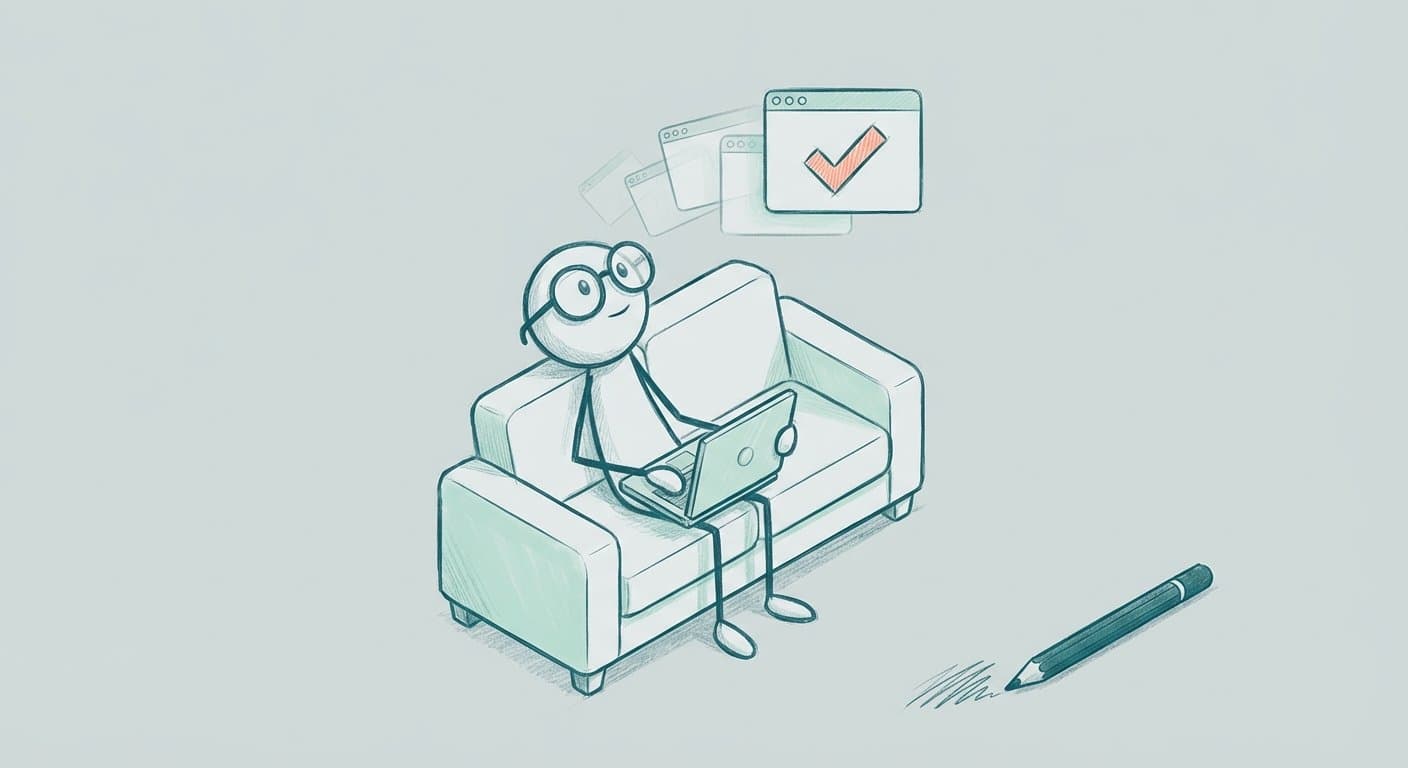
This isn’t a productivity revolution. It’s an evening on the couch with a pen. And afterwards, you know where your biggest lever is.
You are not your business. Your value isn’t measured by whether you think of everything. It’s measured by whether you build systems that do the thinking, so your head stays free for the things only you can do. Client conversations. Creative ideas. Or simply: closing time.
If you feel stuck on the question “What can a system take over?”: that’s exactly where my work begins. 60 minutes where we look at your day together and figure out where the biggest levers are.
Related to This Topic
Get the free Getting Started Guide: 10 concrete ways to start using AI productively tomorrow.
Did this article spark an idea? Let's find out which Sinnvampire can disappear for you.