 software-architecture.ai
Habitat Engineering: The Fourth Discipline That Determines Agent Success
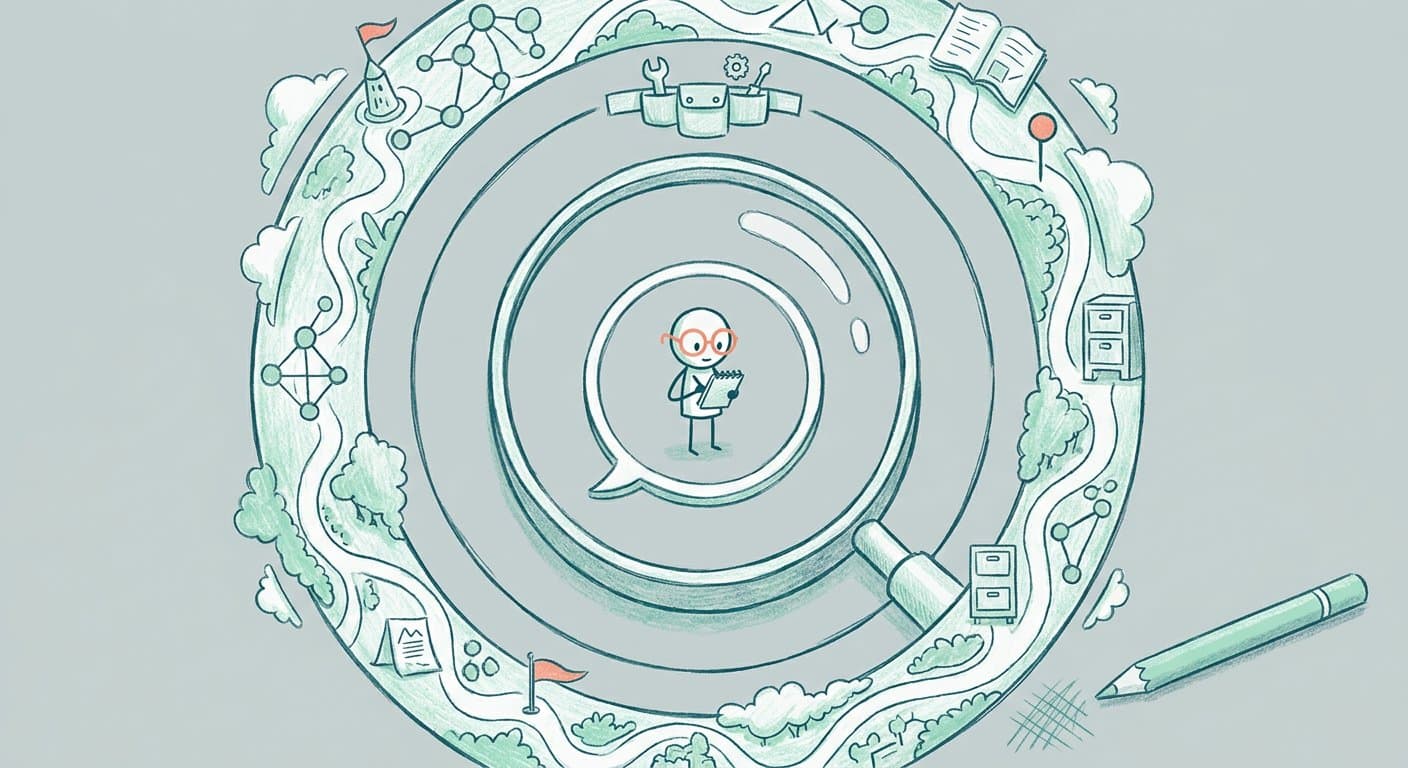
You call the agent. It starts up. It has everything: the right model, the right prompt, the right harness (the agent’s rigging: its tools and system connections). And then it fails. Somehow. For whatever reason. You rewrite the prompt. Give it more context. Add another tool. Fails again. You think: bad agent.
That diagnosis often doesn’t hold.
From working with agentic AI systems: the problem isn’t always the agent. It’s the world the agent lives in. This article is about what I call Agentic Habitat Engineering in my work: the fourth layer in a hierarchy you might already know: Prompt Engineering, Context Engineering, Harness Engineering. And now Agentic Habitat Engineering.
What is Habitat Engineering, and why aren’t Prompt, Context, and Harness enough?
What I call Agentic Habitat Engineering is the work on the environment within the organization, concerned with the world outside the AI agent itself. Not the model, not its instructions, not its toolbox, but the environment in which it operates.
Agentic Habitat Engineering
My working definition for what I experience as the fourth layer after Prompt, Context, and Harness Engineering. It does not shape the AI agent itself, but the world in which it operates: documentation an agent can actually read. APIs that deliver contracts instead of puzzles. Conventions that don't need to be explained first. A chaotic habitat defeats the best agent. A well-designed habitat makes every agent better.
An analogy makes this immediately concrete. Think of cute little creatures from a well-known franchise, the kind you catch, train, and send into battles:
Tier 1, Prompt Engineering: That’s the battle command: “Thunderbolt!” An instruction. What should the creature do? That’s the system prompt, the instruction text.
Tier 2, Context Engineering: What does the creature see right now? What’s in its field of view? In the agent, that’s the context window: tokens, retrieval, memory, RAG.
Tier 3, Harness Engineering: The creature’s rigging. The equipment, the learned abilities, the capture device. In the agent, those are tools, MCP servers, skills, hooks, sandbox.
And then there’s Tier 4: what I call Agentic Habitat Engineering in my work. That’s not the rigging. It’s the land itself. The tall grass that can be explored. The paths that don’t lead nowhere. The rest center that’s actually accessible. The world this creature lives in.
In the agent context, that means: Markdown pages an agent can read. Documented APIs with clear error codes. Knowledge graphs with navigable wikilinks. AGENTS.md, CLAUDE.md, skill files at well-defined locations. Outcome-oriented task descriptions instead of implementation tickets. A /llms.txt in the website root. OpenAPI specs that give agents contracts instead of riddles. Safe writing environments that keep production risk away. Clear escalation paths for decisions an agent shouldn’t make alone. And much more. None of this is infrastructure in the classical sense, no servers, no databases, no networks. Which is exactly why the term was missing.
Operational agent success is a function of model, harness, and habitat. A perfectly equipped agent in a chaotic habitat fails. A well-designed world without a harness is dead. Both are needed. No competition, orthogonal layers.
What AI agents can fundamentally do, and what questions you should ask before deploying them, I covered in “From Prompts to Agents”. Today I go one layer deeper: what kind of world does that agent need to live in to actually deliver?

What’s the difference between Harness Engineering and Habitat Engineering?
In February 2026, Mitchell Hashimoto, founder of HashiCorp and creator of Terraform, described a discipline he called Harness Engineering in a blog post. Source: Augment Code, April 2026. A few days later, OpenAI published their field report, and the term spread. That’s right and important. But I believe the hierarchy doesn’t end at three. It ends at four.
Harness Engineering is agent-centric. It asks: what does the agent work with? Habitat Engineering is world-centric. It asks: what world does it operate in?
The term is deliberately chosen. “Infrastructure” is tech-stack-loaded: servers, databases, networks, cloud. But a CLAUDE.md file isn’t infrastructure. An /llms.txt in a website root isn’t infrastructure. Outcome-oriented task descriptions aren’t infrastructure. The term excludes exactly what’s meant.
“Environment” has a different problem: double occupancy. In ecology. And in the dev/staging/prod context. When you say “agent environment,” people think staging environment. That’s not what’s meant.
“Habitat” is relatively open in the AI discourse. Not to be confused with Meta's AI Habitat, which addresses physical robot simulations: Habitat Engineering here refers to the fourth discipline after Prompt, Context, and Harness Engineering.
What goes into an agent-friendly habitat?
Habitat Engineering can be broken down into clearly defined areas.
Content and Conventions
Start with the simplest: /llms.txt in your website root. That’s a plain text file describing what’s on your website, structured for AI systems rather than people. A table of contents for agents. You create it in ten minutes, and it tells every AI system visiting your site: what’s here? What matters? Where do I start? Instead of an agent trying to parse your JavaScript-rendered page.
An SE Ranking analysis of 300,000 domains found that llms.txt has a 10.13% adoption rate. Sites with llms.txt show 30 to 70% higher accuracy in AI-generated summaries. Source: SE Ranking / linkbuildinghq.com, 2026. That’s Habitat Engineering in ten minutes.
This also includes .md versions of key pages, AGENTS.md and CLAUDE.md at stable locations, and outcome-oriented task descriptions instead of implementation tickets.
API and Data Hygiene
This gets more technical. Gartner research from 2025 shows: only 12% of organizations have data of sufficient quality for AI applications. 85% of failed AI projects cite poor data quality as the root cause. Source: Folio3 AI / Gartner, 2025. That’s not a model problem. It’s a habitat problem.
Concretely: idempotent, documented APIs with clear error codes, not “200 OK with error in the body.” That’s one of the most common anti-patterns. An agent gets a 200 OK, assumes everything’s fine, and acts on false premises. OpenAPI specs and JSON schemas give agents contracts instead of riddles. Sandbox lanes enable safe writes without production risk.
Knowledge Topography
Knowledge needs to be navigable for agents. That means: short, focused pages instead of mega-documents mixing a dozen topics. Linked entries instead of knowledge silos. And: is a claim verified knowledge or an estimate? An agent won’t automatically tell the difference. That has to be explicit in the habitat.
Gartner predicts: 60% of all AI projects without AI-ready data will be abandoned by 2026. Source: Gartner, February 2025. Poor knowledge habitat blocks agent success, regardless of how well prompt and harness are configured.
Identity, Trust, Audit
This is the least visible layer, and the one with the most explosive potential. Every agent needs its own service account. Not shared. Not “we have one dev user for all automations.” NIST launched the AI Agent Standards Initiative in February 2026 with explicit focus on agent security and identity. Source: Strata Identity, 2026.
Why is this a habitat topic and not a harness topic? Because identities and audit structures live outside the agent. The agent doesn’t bring them. They have to be built into the world.
Concretely: every agent gets its own credentials with the smallest possible permission scope. Write access only where writing is actually needed. Read access only to data relevant to that specific workflow. And a complete audit trail for every agent call: which agent, when, on whose behalf, what action on what resource, and with what result? If that question can’t be answered, there’s no audit. Just hope.
The OpenID Foundation put it precisely in 2025: “An API call made by an agent on a user’s behalf is often logged indistinguishably from an action taken directly by the user, creating a black hole for accountability and forensics.” Source: OpenID Foundation, 2025. That’s a habitat failure, not an agent failure.
Organizational Substrate
The last area is the hardest to grasp because it’s not technical. Clear outcome definitions for workflows: the agent should know the goal, not the step-by-step path. Escalation paths to humans, cleanly documented. And: routine versus brand moment separated. When an agent doesn’t know whether something is standard or something special, it guesses. That’s dangerous.
The Habitat Compass: six axes for evaluation
Nobody builds all five areas at once. The Habitat Compass helps you see where you stand and where the next sensible step is. Six axes: three show what the habitat enables the agent to do, three show what it prevents.
The core rule: maximize capabilities, set constraints by default, and both structurally, not procedurally. Procedural constraints decay under pressure. Checklists, reviews, training: they hold as long as nobody has a deadline. Structural constraints (sandbox, default-deny, quotas, approval gates) hold under pressure.
Habitat failures get misdiagnosed as agent failures.
- Bad data? “The agent hallucinates.”
- No conventions? “The agent does weird things.”
- No audit trail? “Something went wrong.”
Built once, useful for every agent: the leverage of the habitat
Agentic Habitat Engineering has a property the other three tiers don’t have: the investment grows with every AI agent. Not linearly. Cumulatively.
If you improve your prompt today, it helps the next prompt. If you improve the context, it helps the next query. If you add a tool to the harness, it helps the next task.
If you build your habitat today, it pays for every future agent that operates there. No re-calibrating. No re-documenting. The /llms.txt exists, every agent reads it. The knowledge graph is structured, every new agent can navigate it.
That’s the decisive difference from the other three tiers: the habitat works for every agent that comes after. Instead of every new agent needing to be re-calibrated, re-documented, and re-secured, it inherits what’s already in the habitat.
Add to this a finding that surprises many: according to an analysis by AI Governance Today / Folio3 AI, 2026, 77% of AI failures are organizational, not technical. That’s not a model problem. It’s a habitat problem. And for small businesses with three systems instead of fifteen: the habitat is easier to build than in any enterprise. Fewer legacy constraints. Less organizational inertia. Building agentic structures in a small business isn’t the stripped-down enterprise project. It’s the clearest entry point.
How do I start with Habitat Engineering?
Three questions you can ask yourself today, without an architecture project, without a budget.
First: Can you set up /llms.txt in ten minutes? If yes, do it. That’s the smallest first step into habitat.
Second: What three questions come up most frequently in your week, and are the answers somewhere an agent could find them? Without asking you?
Third: If an agent took an action in your system today, would you know tomorrow which agent it was, why, and on whose behalf?
If you answer at least one of these with “no,” you have your first habitat ticket.
The four-tier hierarchy is also a structured diagnostic tool: when your agent fails, don’t reflexively start at the prompt. Ask in order: Was the instruction clear? Did it have the right information? Did it have the right tools? And then: could the world actually be navigated? The layer still most often overlooked right now is Tier 4. Chaotic data, undocumented APIs, fragmented knowledge, that looks like a bad agent. It’s a bad habitat.
My take: over the next two years, the practice I describe here as Agentic Habitat Engineering will move from a niche concern to a widespread practice. What name that happens under is not up to me. The terminology is for those who adopt it to decide. But the concept itself, the question of what world an agent actually lives in, I am confident that will hold up. Not for everyone at once, but for those who start asking the right question now. Not: “How do I improve the prompt?” But: “What world does my agent live in?”
The first answers come the moment you start treating your agent like a resident, not a tool.
A well-built habitat doesn’t just keep agents reliable, it keeps the human behind them clear-headed. Why badly-embedded AI burns out the very people who run small businesses, and what the research says about the way out, I’ve gathered in “The Oversight Tax”.
Related to This Topic
Get the free Getting Started Guide: 10 concrete ways to start using AI productively tomorrow.
Did this article spark an idea? Let's find out which Sinnvampire can disappear for you.